

Institutionalizing Strategic Infrastructure Protection in Azerbaijan: The Development of SAPSO
The wars of the last decades in Europe and the Middle East have seen extensive damage inflicted on targets that are not purely military in nature. Among the most heavily affected have been elements of critical energy infrastructure. During the four years of the war in Ukraine, for example, Russia has carried out sustained strikes against Ukraine's energy infrastructure using a wide range of long-range weapons. Ukraine has responded with deep strikes of its own, inflicting significant damage on Russian oil refineries and contributing to fuel shortages across the country. Ukraine's extensive use of sabotage operations through domestic operatives and local collaborators, most notably during Operation Spiderweb, further demonstrates the diverse range of threats facing strategically important infrastructure in the modern era.
The growing importance of critical infrastructure protection also reflects a broader change in the relationship between infrastructure security and national defense. Energy facilities, pipelines, ports, transportation networks and communications infrastructure can provide an adversary with targets whose disruption may produce strategic effects without directly attacking military forces.
Recent conflicts have demonstrated this clearly. During the 2026 conflict involving Iran, critical energy infrastructure across the Gulf was repeatedly targeted, with attacks affecting energy facilities, ports and other economically important infrastructure. This demonstrated how attacks on civilian and commercial infrastructure can be used to impose economic costs and disrupt a state's ability to sustain normal economic activity during a conflict.
For states such as Azerbaijan, whose economy and regional strategic position are closely connected to energy production and transportation, the protection of such infrastructure therefore has implications extending beyond physical security. Maintaining the functioning of pipelines and other strategic facilities contributes to economic resilience, the continuity of energy exports and the state's ability to sustain essential services during a crisis. Infrastructure protection can consequently be viewed as a component of national security in its own right, complementing conventional military capabilities rather than existing separately from them.
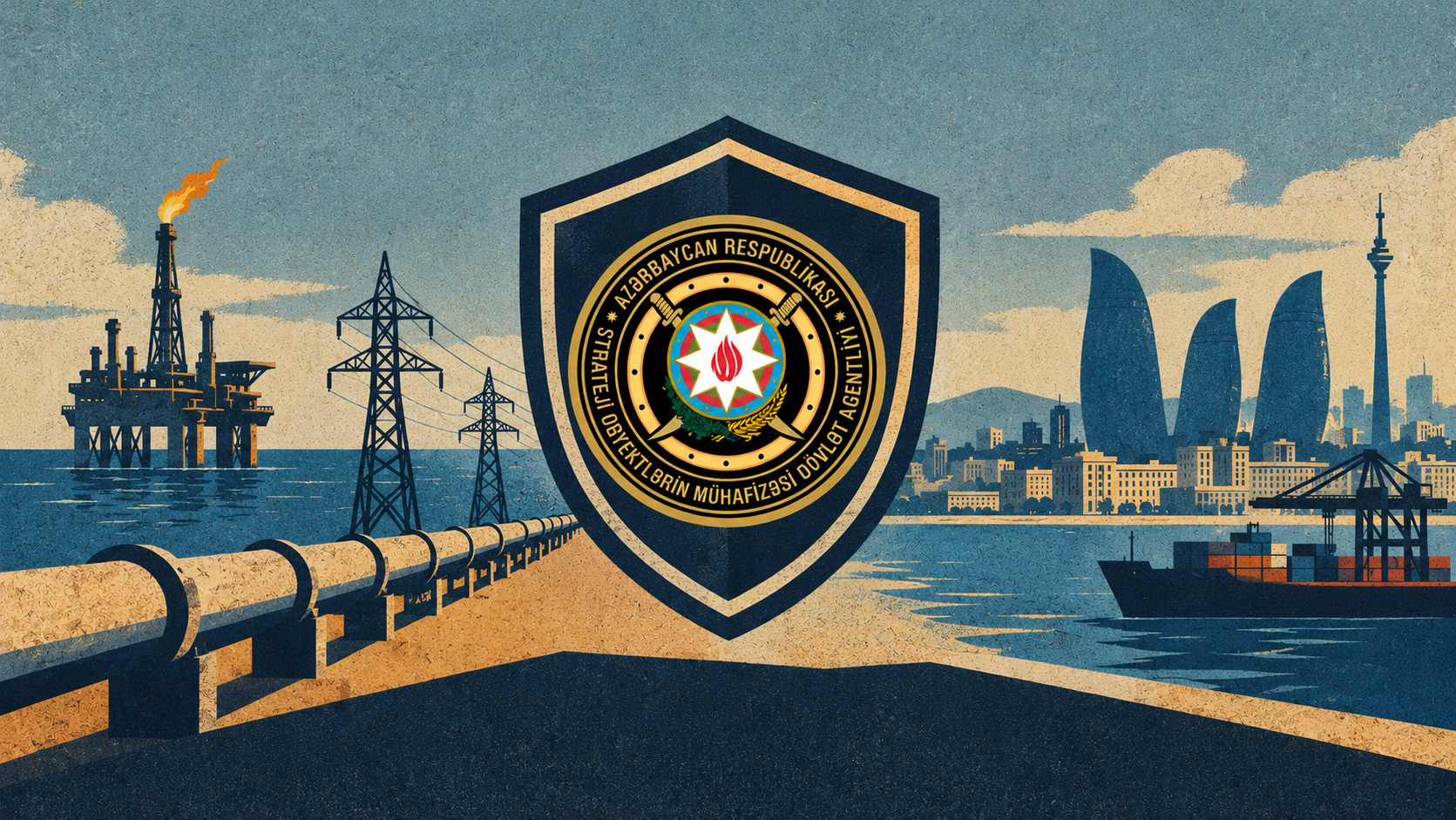
In this context, Azerbaijan provides an example of how states can institutionalize critical infrastructure protection as a distinct component of national security. The establishment of the State Agency for the Protection of Strategic Objects (SAPSO) created a specialized institution responsible for this mission, while its subsequent development has involved dedicated training, coordination with other state institutions and cooperation with private infrastructure operators. SAPSO's growing regional engagement represents a further dimension of this institutional approach.
The history of protecting state personnel and strategic infrastructure in Azerbaijan dates back to the late 1910s, when the first Republic established early agencies for this purpose. More recently, SAPSO's direct predecessor was the Special State Security Service, which was dissolved in 2020. Its responsibilities were divided among three newly created agencies, one of which was SAPSO, suggesting that the latter was established with a more specialized mandate. The agency's legal framework establishes it as a separate institution with its own jurisdiction, legal personality, command structure, and headquarters.
Azerbaijan possesses vast oil reserves and an extensive network of infrastructure related to the extraction and transportation of hydrocarbons. The creation of a specialized agency to protect these assets reflects the strategic importance of ensuring their continued security and operation. By assigning this responsibility to a dedicated institution, Azerbaijan has also established a framework for developing specialized expertise and coordinating the protection of strategic infrastructure across relevant state bodies.
The conduct of regular theoretical and practical training has been one of the defining features of SAPSO's relatively short history. Practical anti-sabotage and counterterrorism exercises are held across different regions of the country, primarily at sites of critical oil infrastructure, such as the recent field exercise in Aghstafa.
In addition, the agency regularly holds meetings with other state institutions, including a recent discussion with representatives of the Ministry of Defense on the air defense of strategic objects. The involvement of other government agencies, such as the Ministry of Emergency Situations, as well as private operators including BP Caspian Sea Exploration, is particularly noteworthy and reflects SAPSO's multi-agency approach to strategic infrastructure protection.
The involvement of private-sector operators is particularly important because many strategic facilities are not directly operated by the state. Effective protection therefore requires security institutions to coordinate with the companies responsible for operating and maintaining critical infrastructure. This creates an additional layer of complexity compared with the protection of conventional military facilities, where responsibility is generally concentrated within the defense establishment. SAPSO's cooperation with energy companies such as BP and SOCAR consequently illustrates the broader institutional requirements of infrastructure security, in which information sharing, joint planning and coordinated responses between public and private actors become part of the security architecture surrounding strategic assets.
SAPSO's development also appears to be continuing rather than representing a completed institutional process. In May 2026, the Azerbaijani president approved amendments to the agency's governing regulations, structure, personnel limits and senior officer positions, explicitly citing the improvement of SAPSO's activities as one of the purposes of the changes. At a September 2026 service meeting, the agency identified measures to improve its activities in line with modern requirements, increase personnel preparedness for different types of potential threats, and expand its capacity for flexible action. The meeting also addressed the development of management skills, the professionalization of personnel, and the establishment of a unified approach across SAPSO's regional structures.
These developments suggest that the institutionalization of strategic infrastructure protection in Azerbaijan should not be understood as a process completed with SAPSO's establishment in 2020. Rather, the agency continues to adapt its organizational structure, personnel and operational practices in response to changes in the broader security environment.
The agency has also demonstrated its practical ability to fulfill its responsibilities. In late 2023, SAPSO reported that, together with the Azerbaijan Mine Action Agency (ANAMA), it had identified and neutralized explosive devices near the Baku-Tbilisi-Ceyhan oil pipeline in the Tovuz region.
SAPSO's institutional development has also acquired a regional dimension. The agency has been a key participant in the "Eternity-2024" and "Eternity-2025" joint exercises conducted with Turkey and Georgia. These exercises have focused on different aspects of protecting strategic and economic infrastructure while also strengthening regional cooperation and dialogue.
The agency is also expected to participate in this year's exercise alongside representatives of Azerbaijan Railways. Scheduled to take place in Azerbaijan in November, "Eternity-2026" will focus on the protection of critical communication lines.
Alongside developing practical skills and operational experience, these exercises provide valuable opportunities to strengthen regional dialogue and facilitate the exchange of experience between participating countries. During the "Eternity-2024" exercise, SAPSO's Deputy Chief and a senior General of Georgia's Ministry of Internal Affairs held a meeting to discuss prospects for future cooperation and exchange views on the protection of strategic infrastructure. Such interaction is particularly valuable in a region that shares critically important energy infrastructure and has found itself in an increasingly unstable security environment over the past several years.
The institutionalization of strategic infrastructure protection through SAPSO reflects Azerbaijan's recognition that critical infrastructure security has become a specialized task requiring dedicated institutions, regular training, and close coordination with other state and private entities. While the agency's activities remain largely preventive and have received relatively little public attention, its practical exercises, operational experience, institutional development and growing regional engagement indicate that Azerbaijan is treating the protection of strategic infrastructure as a distinct component of national security rather than merely a supporting function of other security services. As attacks on critical infrastructure continue to play an increasingly prominent role in modern conflicts, Azerbaijan's approach demonstrates how specialized institutions can complement broader national defense efforts while also strengthening regional cooperation around shared strategic assets.