


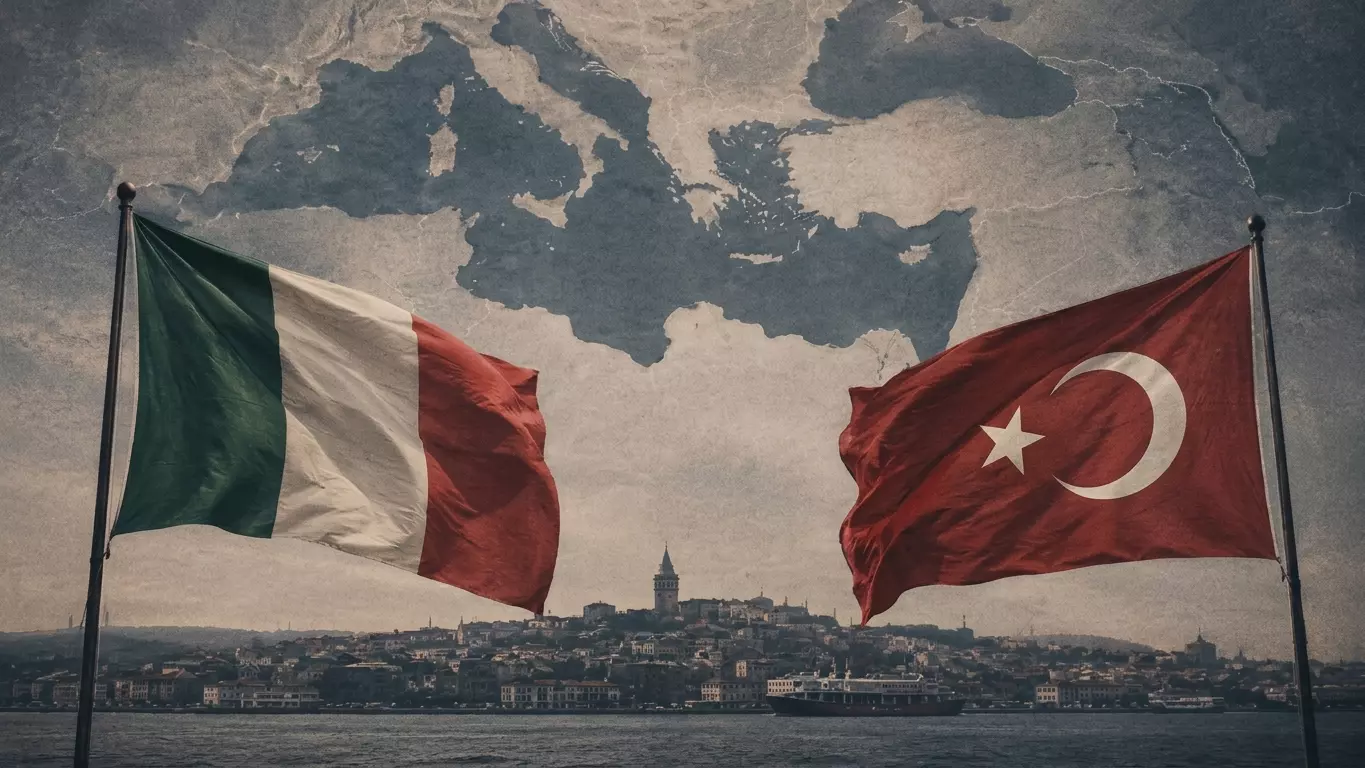

On 20 October 2026, in Benghazi, Libya’s eastern-based House of Representatives, the country’s recognised legislature, unanimously ratified the 2019 maritime memorandum that Türkiye signed with Tripoli’s then UN-recognised Government of National Accord. In the same session, lawmakers repealed two 2020 resolutions with which they had rejected the deal and called for political ties with Ankara to be severed. By reversing a position it had held since 2020, the eastern parliament allowed Türkiye to take a major step in the contest for the Mediterranean and, at least on paper, redraw the maritime map of the eastern basin.
For Rome, Libya is no longer mainly a colonial memory: it sits at the core of Italy’s “enlarged Mediterranean”. Eni is the largest foreign operator there, and the country is an essential pillar of Rome’s political and economic projection beyond its shores. Türkiye’s growing weight in Libya therefore risks unsettling a delicate balance along the Rome–Ankara axis, one carefully built over the years on compromise and mutual advantage in defence and energy security, and underpinned by the $40 billion trade target the two governments set in April 2025.
The memorandum may thus become a test for what has turned, over time, into a method rather than a contradiction. Divided by competing interests yet bound by shared ones, Rome and Ankara have learned to compete and cooperate at the same time, a dynamic known as coopetition. Rome has managed it by compartmentalising: it leaves disputes over maritime law to Brussels, where Italy is one voice among 27, and engages Ankara directly on drones, air defence and gas. The question now is how far this division of labour can stretch, once Türkiye’s maritime claims carry a pan-Libyan endorsement. The test comes as two national projects, Ankara’s maritime doctrine of the Blue Homeland (Mavi Vatan) and Rome’s Africa strategy, the Mattei Plan, pull the two countries across the same sea.
Ankara’s Ladder: From Tripoli’s Protector to Pan-Libyan Partner?
Türkiye’s current position in the Eastern Mediterranean is not a surprise but a culmination, reached rung by rung.
The first, and decisive, rung was Tripoli. In November 2019, besieged by eastern forces led by Field Marshal Khalifa Haftar and backed by the United Arab Emirates, Russia and Egypt, the Government of National Accord (GNA) led by Fayez al-Sarraj signed two memoranda with Ankara. In effect, the deal traded protection for recognition. Türkiye pledged military support, and Tripoli endorsed its maritime ambitions by agreeing to a shared maritime boundary between the Turkish and Libyan coasts that disregarded the entitlements of the Greek island of Crete. By June 2020, backed by Turkish drones and air defences, GNA forces managed to halt Haftar’s offensive, and Türkiye emerged as the de facto protector of western Libya.
The second rung was built more quietly, in the east, where Ankara spent the post-war years courting the camp it had fought, above all through Saddam Haftar, the commander’s son and likely heir. Until 20 October, however, Ankara’s maritime ambitions had run up against the eastern parliament’s refusal to approve the memorandum, which remained in limbo for six years. The deadlock broke on 6 October, when Aguila Saleh, one of its most prominent opponents, was replaced as speaker. By ratifying the deal two weeks later, Libya’s House of Representatives signalled that the agreement enjoys support on both sides of the Libyan divide, handing Türkiye a strategic success in the region.
While the vote may have settled the matter at home, the same cannot be said internationally. On the very evening of the ratification, the presidents of the European Council and the Commission, António Costa and Ursula von der Leyen, called the agreement “null and void”. The next day, the EU’s High Representative Kaja Kallas reiterated that position on behalf of the EU, while Athens, Nicosia and Cairo rejected the vote outright.
What began as a wartime bargain with Tripoli now looks like a lasting Libyan endorsement of Türkiye’s vision of the Mediterranean, one whose reach extends well beyond Libya, into waters where Italy has real interests at stake.
Two Visions, One Sea
For almost two decades, Ankara’s maritime ambitions in the Mediterranean have gone by the name of Mavi Vatan. First formulated around 2006 by Admiral Cem Gürdeniz and later refined by Rear Admiral Cihat Yaycı, who is also regarded as the architect of the 2019 accord with Libya, the doctrine claims Turkish jurisdiction over vast maritime areas in the Black Sea, the Aegean and the Eastern Mediterranean.
Although for years it was dismissed as an abstract thesis, a series of naval operations off the Cypriot and Greek coasts since 2019, some of which escalated into incidents, as in the case of the Oruç Reis, have turned that thesis into practice. Libya is not merely the latest theatre of Ankara’s ambitions but their legal keystone: Ankara filed the memorandum with the UN within days of its entry into force and has invoked it ever since as the basis of its claims, which the Benghazi vote now consolidates.
Italy, for its part, has never concealed its growing interest in Africa and, more broadly, in what Rome calls the “enlarged Mediterranean”, an area that stretches west past Gibraltar and east to the Black Sea, the Red Sea and the edge of the Indian Ocean. This space has found its fullest strategic expression in the Mattei Plan, a programme launched in January 2024 to promote development and energy partnerships, which today counts 76 projects in 18 African countries and for which the Mediterranean basin is an indispensable piece.
These two overlapping postures rest on a delicate balance that, over the years, has seen moments of rupture and geopolitical friction. A case in point came in February 2018, when Turkish warships turned back a drillship working for Eni off Cyprus; Rome raised the issue with Ankara, but within weeks the ship had sailed for Morocco, the well undrilled.
In this context, the Libyan accord now brings that friction to one of Italy’s key energy footholds. In Libya, Eni has operated since 1959 and ships gas to Sicily through the GreenStream pipeline, making Libya one of Italy’s main energy suppliers. While the Benghazi vote moves no Italian boundary and places no Eni field under Turkish jurisdiction, its effect is political: both Libyan camps now accept Ankara as their partner in defining the country’s waters, and those are the waters in which Eni operates.
The Cooperation Puzzle
Despite the interests outlined above, relations between Rome and Ankara have recently been marked by a surprising degree of cooperation, in contrast with the past. The response to the Benghazi vote is a case in point.
While in January 2020, then Foreign Minister Luigi Di Maio and his Cypriot counterpart declared the memorandum “unacceptable”, as it infringed the sovereign rights of third states, October’s developments were met with an unusual silence from Italian institutions. Yet the two-track approach is not new: weeks before the Di Maio statement, Rome had declined to sign the Cairo declaration in which Egypt, France, Greece and Cyprus called the memorandum “null and void”. As Il Foglio reported, criticism of the agreement reached Ankara only through Brussels, while Palazzo Chigi merely referred to the EU’s position on what should be a matter of primary importance for Italy’s strategic interests.
Part of the explanation may lie in the complementarity that the governments in Rome and Ankara have built in recent years. Embracing a crisis-as-opportunity logic, they have repeatedly turned contested ground into joint business, above all in defence and energy.
Particularly significant was the June 2026 decision by which the Council of Ministers cleared, under its golden power rules, LBA Systems, the 50/50 joint venture between Leonardo and Baykar for the design, development and production of unmanned aerial systems. Albeit within limits, chief among them the reported obligation to direct its international activities only towards countries aligned with NATO and the EU, the partnership has already led the Italian Air Force to order six drones: aircraft of Turkish design, supplied by an Italy-based joint venture, that thus enter the arsenal of an EU and NATO member. Ankara, for its part, has been negotiating the purchase and co-production of the Franco-Italian SAMP/T air-defence system, while in June Italy deployed one of its own batteries to Konya under NATO’s defence plans. On 27 October Turkish energy minister Alparslan Bayraktar said he hoped to “soon make a major announcement with Eni”, a project the Italian company has yet to confirm.
This complementarity, together with the absence of explicit statements, reflects the strategy through which Rome navigates the relationship: compartmentalisation.
A Model or a Risk?
Thus, although geography and overlapping interests might cast Ankara and Rome as natural rivals, their recent relationship shows otherwise. In the near term, however, Italian–Turkish relations will have to reckon with a number of open fault lines that are bound to stress-test the balance between the two countries.
The first may well be Libya itself, where in February, in the country’s first licensing round since 2007, Eni secured an offshore block, and a consortium including Türkiye’s state-owned TPAO won another off Cyrenaica. Closely linked is the question of Cyprus, where on 26 October, between the ratification and Bayraktar’s announcement, Eni launched the execution phase of Cronos, meant to bring the first Cypriot gas to market in 2028. The field lies in Block 6, part of which Ankara claims as its own continental shelf, and the project moves ahead despite the 2018 precedent, at a time when, unlike then, Leonardo and Baykar share a production line.
The third front is Africa. Four days after Giorgia Meloni co-chaired the second Italy–Africa Summit in Addis Ababa, Recep Tayyip Erdoğan made his first official visit to Ethiopia in eleven years, signing an energy agreement with one of the Mattei Plan’s first partners. Here too the line between cooperation and competition is thin, although both sides seem, for now, to read the overlap as an opportunity.
The fourth front is the elephant in the room: the European Union. Although Ankara’s European ambitions are dormant at best, with accession negotiations at a standstill since 2018, Türkiye remains a partner in which, by the European Council’s own account, the Union has a strategic interest. Tellingly, Erdoğan’s government formally applied to join SAFE, the €150 billion defence-loan instrument, only to see Greece and Cyprus stall the bid, with Athens making its consent conditional on the withdrawal of the casus belli Ankara has maintained over the Aegean since 1995. This limbo sits uneasily with Türkiye’s role as a key NATO member and custodian of the Straits under the Montreux Convention, which it invoked to close them to belligerent warships after Russia’s invasion of Ukraine. The agreements with Rome thus raise a question no one has yet had to answer: could drones of Turkish design, supplied by a company registered in Italy, pass through a door that remains closed to Türkiye?
How far, then, can this balance be pushed? One could argue that Ankara’s growing weight on both shores of Libya leaves Italy no choice but to follow in its wake. The opposite reading casts Rome as both gatekeeper of and gateway to Europe, able to set the terms on which Turkish industry may enter the continent’s defence market, which would give Rome considerable leverage over the trade-offs Ankara will have to make.
Whichever reading prevails, the Italian case speaks beyond the bilateral relationship. Rivals by geography, Italy and Türkiye have so far behaved as partners by design, cooperating where they can without pretending to agree where they cannot. Could that method offer a key for Europe as a whole in negotiating with its neighbours? In principle, the EU already subscribes to it, pledging to engage Ankara in a “phased, proportionate and reversible manner” in areas of common interest. In practice, the method comes with a limit: if Rome can keep the files apart because it does not stand on the front line, for Athens and Nicosia, which do, they remain a single file. Whether compartmentalisation can become a European method, rather than remain the privilege of those far enough from the dispute to afford it, is the question this balance leaves open.