




Photo: Ministry of Defense of Azerbaijan
Azerbaijan is modernizing its air force through domestic and international training programs, new procurement agreements, and efforts to build its local defense industry. Developments over the past year reflect a firm commitment to transforming the air force into a more capable, professional branch of the armed forces. While modern warfare discussions often focus on unmanned systems, recent conflicts prove conventional air power remains vital. Establishing air superiority, conducting precision strikes, and supporting ground operations remain top priorities for many militaries.
These upgrades fit into Azerbaijan's broader strategy to strengthen and diversify its military capabilities. Having invested heavily in ground forces, built a substantial drone fleet, and expanded naval capabilities with unmanned surface vessels, the country is forging a diversified, technologically advanced military. A modernized air force is a critical piece of this transformation, complementing existing assets and boosting overall combat effectiveness. Paired with growing international cooperation and expanded procurement, these moves point toward a far more capable armed force.
Azerbaijan's military aviation dates back to 1919, when the Azerbaijan Democratic Republic began sending personnel abroad for pilot and aviation training. Following the restoration of independence, the Azerbaijani Air Force was formally established as a separate branch on 14 February 1992.
Given its Soviet past, Azerbaijan's initial inventory consisted almost entirely of Soviet-designed aircraft. This dependence lasted for years, though the fleet gradually diversified with foreign training and transport aircraft. Still, until recently the core combat aviation consisted entirely of Soviet-era platforms, particularly the MiG-29 fighter and Su-25 attack aircraft.
The biggest recent shift was therefore the introduction of the JF-17, a Chinese-Pakistani multirole fighter marking Azerbaijan's first major move away from its traditional Soviet-origin fleet toward modern combat jets. The remaining combat inventory still relies on Russian-origin MiG-29s and Su-25s alongside Mi-series helicopters. This includes the Su-25 Laçin modernization program - developed with Türkiye's Turkish Aerospace Industries (TUSAŞ) - which integrates modern avionics and Turkish precision-guided weapons into the Soviet airframe. Meanwhile, supporting aviation fleets have steadily added Western and Turkish platforms for training and transport roles.
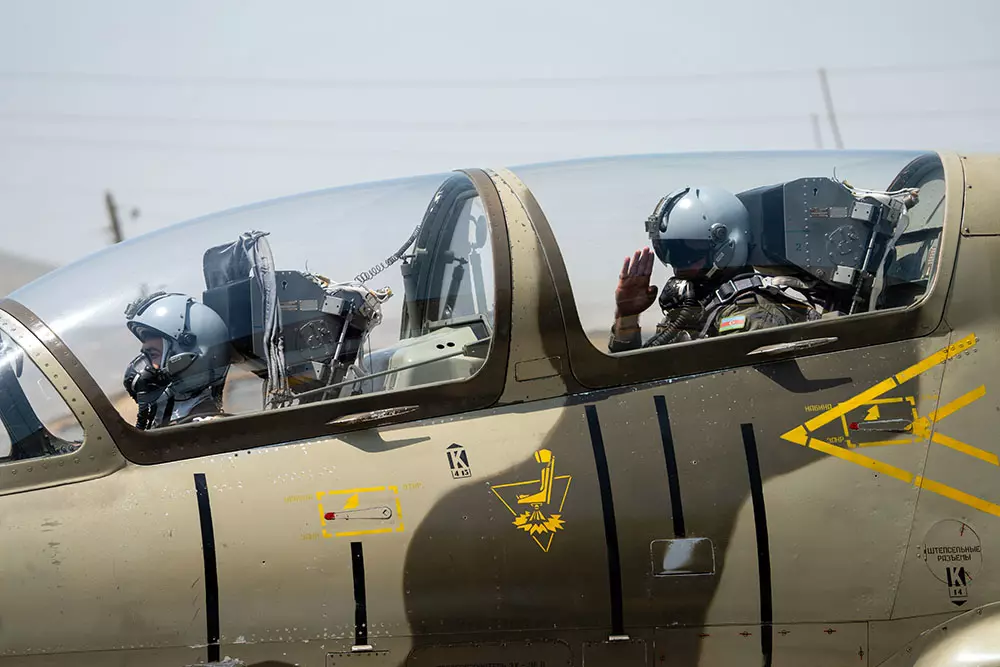
Alongside hardware upgrades, Azerbaijan is sharpening pilot training and operational proficiency. Recent drills combine classroom instruction with practical flight training, covering basic maneuvers, take-offs, and landings. While fundamental, these exercises reflect a sustained push to maintain and upgrade personnel skills.
International cooperation is central to this effort. In 2026, two Azerbaijani helicopter crews underwent NATO Evaluation Level-2 in Baku to raise operational standards and interoperability. Azerbaijan also expanded practical cooperation with the UAE through the Falcons Meet 2026 exercise involving helicopters and fighter jets, following a meeting between the Azerbaijani and Emirati Air Force commanders on deeper collaboration.
Air assets also participated in the Power of Unity 2026 exercise, where helicopters practiced troop insertions, extractions, and air-to-ground strikes, while fighters executed maneuvers and rocket launches. Incorporating live ground-attack drills demonstrates a clear push to build operational capabilities beyond routine flight proficiency.
Azerbaijani pilots also joined the Anatolian Eagle 2026 international tactical exercise in Türkiye, expanding their exposure to multinational operations. Separately, a Pakistani flight instructor confirmed that Pakistani Air Force instructors are actively training Azerbaijani pilots on the newly acquired JF-17s. The JF-17 delivers a major upgrade over aging MiG-29s with modern avionics and multirole capabilities, decisively breaking Azerbaijan's traditional reliance on Russian-origin combat aircraft.
In addition to the new fighter jets, in September 2026 Azerbaijan signed a contract for the acquisition of 14 Turkish HÜRKUŞ-II training aircraft, which would help with pilot training and deepen defense-industrial ties with Türkiye. Bringing in a dedicated modern trainer is vital as the air force expands its fleet and transitions to advanced jets.
Beyond procurement, Azerbaijan is expanding domestic defense production. At ADEX 2026, Türkiye's ASELSAN and Azerbaijan's NOVASIS signed an agreement targeting the establishment of a defense manufacturing facility in Nakhchivan. The plant is expected to produce laser guidance kits, precision-guided munitions, and air-defense systems.
Once operational, it could build local technical expertise and help cut reliance on foreign suppliers, supporting the broader modernization of Azerbaijan's aviation and air-defense capabilities.
These investments reflect Azerbaijan’s enduring commitment to developing conventional air power in an era dominated by unmanned systems. There is evidence that this commitment is not misplaced. While recent wars have proven beyond a doubt that drones reshape battlefield operations, they have not made traditional aviation nowhere near obsolete.
The war in Ukraine illustrates this clearly: despite heavy drone use for reconnaissance, precision strikes, and ground attacks, neither side has secured air superiority. Drones operate effectively in that vacuum, yet their limitations against conventional jets remain obvious. Drones have primarily altered ground combat and cannot independently challenge air superiority, lacking the speed, altitude, and air-to-air capabilities to challenge modern fighters.
At the same time, manned aircraft have proven vital for countering UAV threats. Ukrainian F-16s have reportedly shot down roughly 4,700 Russian drones, including 1,100 in October 2026 alone. Pilots increasingly rely on internal cannons rather than expensive air-to-air missiles, providing a cost-effective way to intercept mass drone attacks. Rather than being displaced by unmanned threats, conventional aviation is adapting to defeat them.
Asset vulnerability is another critical factor. Ground and naval forces are increasingly exposed to cheap drones and unmanned surface vessels. Aircraft flying at proper altitudes under favorable conditions face far less exposure to the small tactical drones threatening ground troops. Aviation is not invulnerable - modern air defenses, enemy fighters, and low-altitude operations still pose serious risks - but conventional air power provides capabilities that remain difficult to replace.
For Azerbaijan, air force modernization is a logical extension of its broader military buildup. The country has already invested heavily in ground forces, built a capable UAV fleet, and introduced unmanned surface vessels for coastal defense. A modern air force complements these assets and creates a balanced, diversified military.
Combining better pilot training, modern jets, international partnerships, and supporting systems strengthens coordination across military branches, helping build a true combined-arms capability.
With the JF-17 Block III, Azerbaijan has taken a major step forward, though further fleet expansion and supplier diversification remain likely. One notable option is China's J-10CE multirole fighter. At ADEX 2026, China drew attention by displaying a full-scale J-10CE model in Azerbaijani Air Force markings. While no procurement deal has been announced, engagement has been building: Azerbaijan's Air Force commander inspected the J-10 at a 2024 airshow in China, and reports from ADEX 2026 noted that President Ilham Aliyev signed the displayed model. This does not confirm a purchase, but it signals serious engagement that makes the J-10CE a realistic future option.
The existing JF-17 deal makes deeper cooperation with Chinese suppliers particularly attractive. Azerbaijan is already gaining experience with Chinese aviation systems and building ties with Chinese and Pakistani defense industries - an institutional advantage if Baku pursues additional Chinese platforms.
Türkiye's KAAN fifth-generation fighter is another natural option given Baku's close defense partnership with Ankara. However, the program is still under development, leaving its operational timeline and export availability uncertain. While KAAN is an attractive long-term prospect, Azerbaijan would wait years for meaningful deliveries, whereas the J-10CE is already operational with an established export pipeline.
Other suppliers carry distinct trade-offs. Israel, despite being a top defense partner, does not build or export fighter jets. Russia remains a great theoretical option given Azerbaijan's existing maintenance infrastructure, but the war in Ukraine, production constraints, and increasingly shifting political dynamics between Baku and Moscow make future deals questionable. Azerbaijan has steadily diversified away from Russian arms, and choosing the JF-17 over familiar Russian platforms signals a deliberate push to cut dependence on Moscow's defense industry. China therefore stands out as one of the strongest candidates for future fighter purchases if Baku expands beyond the JF-17.
Overall, Azerbaijan's air force modernization marks a pivotal shift in the evolution of its armed forces. Through new aircraft, sharper pilot training, international exercises, and planned domestic production, Baku is moving past its reliance on Soviet-era aviation. Challenges will remain around integration, maintenance, and long-term sustainment, but the trajectory is clear. Combined with strong ground forces, unmanned systems, and naval upgrades, a modernized air force promises a balanced, integrated military capable of operating effectively across every domain of modern warfare.