



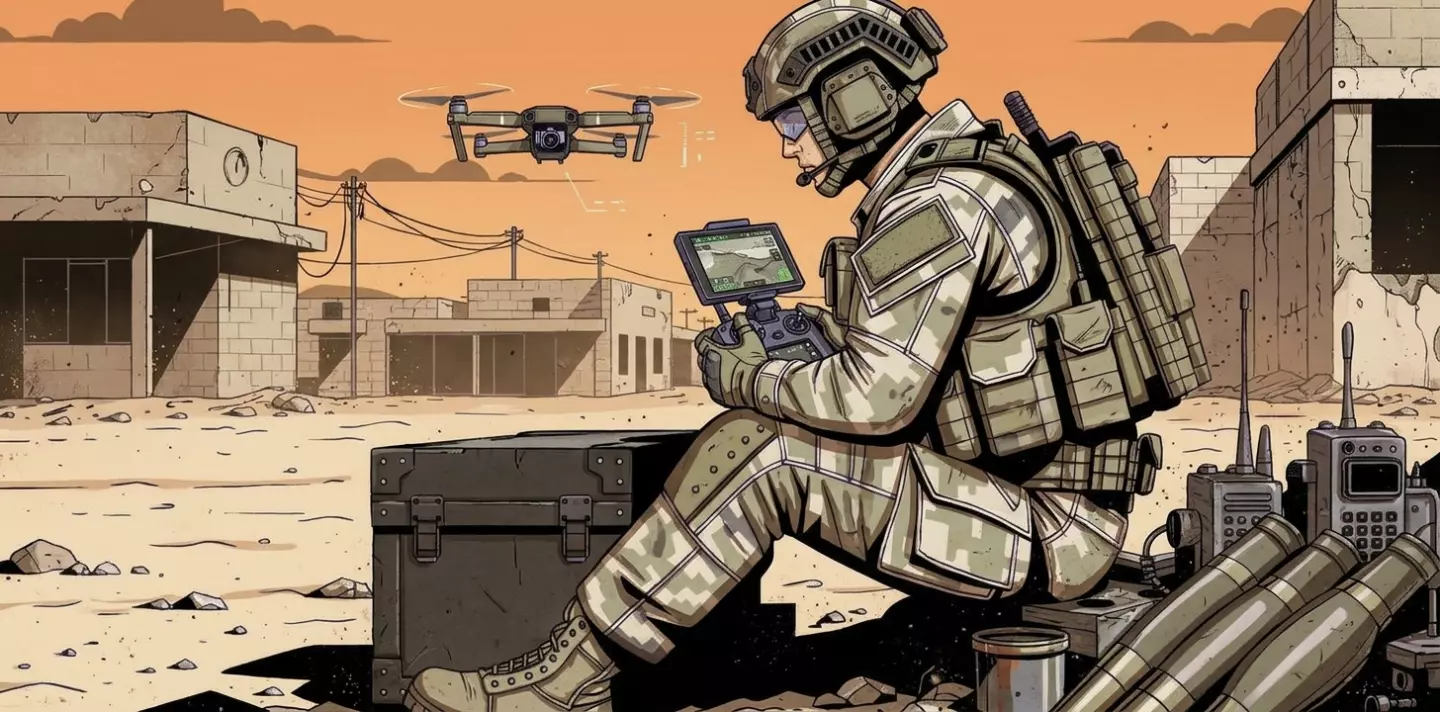

Video games have maintained a presence within armed forces around the world for many years, primarily serving as instruments of entertainment and team-building. However, militaries have also recognized their potential to help soldiers develop skills relevant to real-world operations. Until recently, these applications remained relatively limited. The rapid proliferation of unmanned aerial systems (UAS) in modern warfare is now giving gaming a much more significant role in military training, particularly in the selection and preparation of drone operators.
As operating unmanned systems increasingly involves skills familiar to experienced gamers, militaries are beginning to incorporate video games and specialized simulators into their training programmes. Gaming is therefore moving beyond its traditional recreational role and becoming a practical supporting tool for modern military organizations. At the same time, military esports competitions continue to serve as a means of improving morale and strengthening cohesion among soldiers.
One of the more recent developments in military recruitment in some countries is the recognition that gaming experience can provide a useful starting point for identifying potential UAS operators.
Players accustomed to handheld controllers and joysticks are already familiar with operating controls without looking at them, coordinating complex movements and making rapid adjustments while observing a screen. This can significantly reduce the initial learning curve when transitioning to remotely operated systems. The relevance of these skills is illustrated by Ukraine's Tanchik Droid 12.7 unmanned ground vehicle, which can use a conventional PlayStation controller to operate its remotely controlled weapon system.
Scientific research has also identified links between video gaming experience and UAS operator performance. A 2011 study found that experienced gamers performed significantly better than participants without gaming experience in several UAS-related tasks. In some areas, their performance was comparable to that of experienced drone pilots. These findings suggest that gaming can develop transferable skills, including visual tracking, hand-eye coordination and rapid information processing. Such experience could therefore be useful when assessing candidates for drone operator positions.
Some militaries are already taking this into account. Kazakhstan reportedly considers recruits' experience with virtual flight simulators when allocating personnel to UAV-related positions. In Russia, a training facility in Tatarstan uses a game called “Battle of Drones” to assess candidates' strategic thinking and help decide whether the recruit should become an engineer or a drone pilot. The United Kingdom has also recognized the military potential of gaming, drawing on lessons from Ukraine to launch the International Defence Esports Games, an initiative involving military personnel from allied countries to develop digital and cyber skills through competitive gaming. The programme reflects growing recognition that gaming can help develop abilities relevant to modern warfare, including rapid decision-making, threat tracking, coordination and, increasingly, drone operation.
The use of gaming in military drone programmes extends beyond identifying suitable recruits. Drone simulators are increasingly becoming part of the training process, allowing new operators to develop basic flying skills before handling actual equipment.
Their main advantage is the ability to practise repeatedly without risking expensive drones or requiring extensive logistical arrangements. They can also recreate complex scenarios that would be difficult or costly to organize during conventional field exercises. This makes them particularly useful for rapidly training large numbers of recruits and preparing them for practical instruction.
Ukraine provides a concrete example. Various units of its armed forces are using simulators developed by L7 Simulators to train drone crews, including operators of interceptor drones. The software allows instructors to recreate realistic combat scenarios and practise coordination between pilots and navigators. Trainees can repeat exercises as often as necessary without consuming equipment or risking physical damage. Similar initiatives are emerging elsewhere.Russia's QuadroSim Pro, for example, is specifically designed for training military personnel and students at military educational institutions. It offers different drone configurations, flight environments and training scenarios, and can be used with FPV goggles and physical controllers. According to the company, its wider QuadroSim product line is already used by more than 800 educational institutions and organizations across Russia, including defence industry producer Almaz-Antey. Commercially available platforms such as FPV Labs also provide accessible environments for beginners to practise flying without risking physical equipment.
The integration of simulation into military training is not limited to Ukraine and Russia. In September 2026, a Russian training facility in Tatarstan reported using GTA V and Arma 3 at different stages of its drone operator preparation programme. Meanwhile, Croatia recently conducted its first International FPV operator training course for Slovenian military personnel. The programme included simulator-based flying alongside theoretical instruction, practical exercises and tactical training. These examples demonstrate that simulators are becoming an established component of drone operator preparation, including in international military training programmes.
Despite their growing usefulness, video games and simulators cannot replace conventional military training. Virtual environments cannot fully reproduce the conditions of actual operations, where operators face equipment failures, signal disruption, electronic warfare, adverse weather and the consequences of mistakes.
More importantly, operating a drone in combat involves psychological pressures that cannot be replicated through simulation. Losing a virtual drone is fundamentally different from losing expensive equipment or failing to complete an actual mission. The ability to operate a simulator therefore does not automatically translate into competence under battlefield conditions.
These limitations are also recognized by military personnel themselves. Russian instructors involved in military esports initiatives have emphasized that gaming should complement rather than replace practical training. Even specialized simulators cannot provide completely realistic drone controls or reproduce every aspect of actual operations.
Effective preparation still requires theoretical instruction, technical knowledge, practical flying, equipment handling and coordination with other personnel. Treating simulators as a cheaper replacement for the entire training process would therefore undermine the very skills they are intended to develop.
There are also broader ethical and psychological concerns surrounding the integration of gaming into military culture. One argument is that competitive shooter games, where success is measured by the number of opponents eliminated, risk normalizing violence and reducing the perceived significance of killing. This concern becomes particularly relevant when applied to military personnel, whose professional responsibilities involve the use of lethal force. The distinction between playing a shooter game and engaging a real target is substantial, but the increasing overlap between gaming culture and military activities raises questions about how soldiers perceive violence and their responsibilities. The growing physical and psychological distance between operators and their targets, particularly in remote warfare, makes these questions even more relevant.
The growing practical value of video games and simulators in military activities is an important development of the drone warfare era, yet it remains relatively under-reported and is sometimes underestimated. What was traditionally associated primarily with entertainment and recreation is increasingly being recognized as a useful tool for identifying potential operators, developing relevant skills and supporting military training. Although UAVs have been the main focus so far, the emergence and proliferation of other unmanned platforms, including unmanned ground vehicles (UGVs) and unmanned surface vessels (USVs), are likely to expand these applications. As militaries increasingly rely on such systems, the transferability of gaming skills and the use of specialized simulators may become more prominent in both operator recruitment and training.
However, the longer-term direction of this trend will also depend on the development of autonomous systems. If advances in artificial intelligence significantly reduce the need for human operators to continuously control unmanned platforms, the demand for specialized operator training and recruitment may decline accordingly. How this will affect the role of gaming and simulation in military preparation remains to be seen. Their recreational and entertainment functions, meanwhile, are unlikely to disappear.
For now, the observable trend is clear: militaries across different countries are increasingly recognizing the relevance of skills developed through video games and the value of simulators as relatively inexpensive and effective additions to conventional operator training. As unmanned systems continue to evolve, this relationship between gaming, simulation and military capabilities is likely to become increasingly significant.