


The antagonistic relationship between the proverbial “East” and “West” is gradually re-entering the discourse of International Relations scholars amid what many see as the resurgence of great power competition. This dichotomy between two spheres of influence—from the colonial Occident versus Orient, to the modern Pax Americana versus the so-called “Axis of Upheaval”—shall survive forever in international politics so long as great powers seek to “maximize [their] share of world power, which means gaining power at the expense of other states”.
Nowhere is this East-West rivalry more evident than in Eurasia, where for nearly three centuries Western powers have sought to encroach on the sphere of influence of the Kremlin, especially when the Russian bear appeared weakest. The nations inhabiting the vast expanses surrounding the Black and Caspian Seas—Georgia, Ukraine, Azerbaijan, and Moldova—have borne the brunt of this geopolitical struggle, often finding themselves pawns in Russian and Western alliance-making. Their unique territories, histories, and cultures have forced them to choose sides, navigating a precarious balance of survival.
Realist scholars have long studied this struggle, primarily through the lens of great powers, focusing on how one state—through force or diplomacy—manages to bring smaller nations under its sphere of influence, thereby outmaneuvering its rival. This narrow perspective overlooks the agency and experiences of the nations caught in the crossfire. For these states, the East-West rivalry is not merely a theoretical game of power but an existential fight for survival.
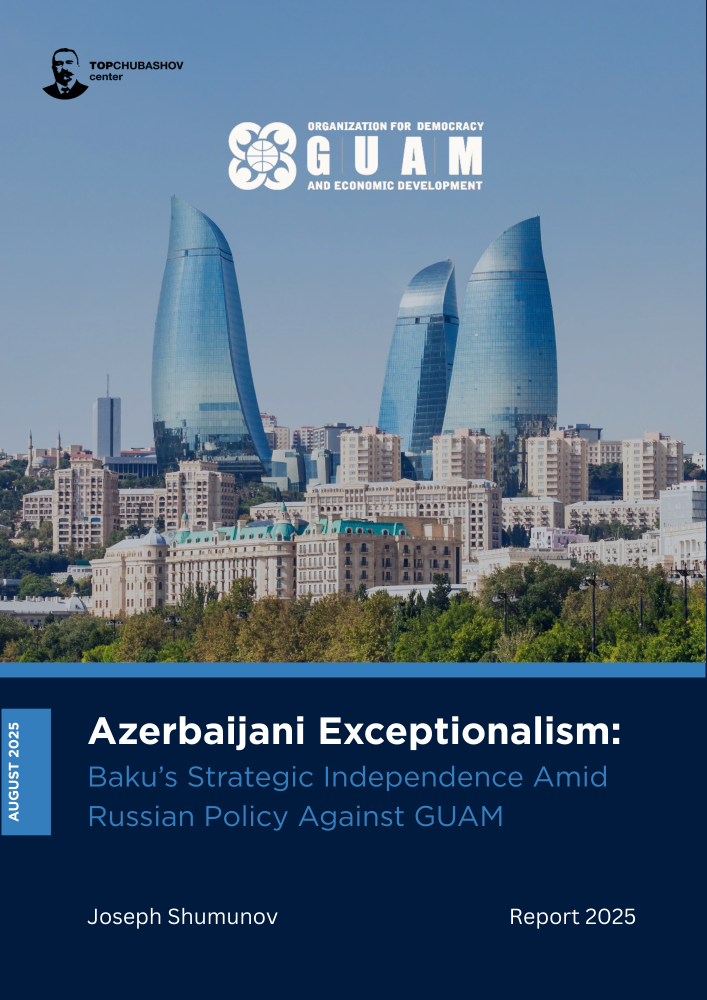
While Georgia, Ukraine, and Moldova have struggled to deter Russian domination, Azerbaijan has emerged as an exception to this trend. Following its victory in the 2020 Karabakh War, Azerbaijan successfully removed Russian forces from its territory, maintained strong diplomatic ties with the Kremlin, and simultaneously cultivated a robust partnership with NATO—all without provoking significant Russian reprisal. This strategic independence sets Azerbaijan apart and challenges conventional narratives about the post-Soviet space.
What unites the four GUAM nations (Georgia, Ukraine, Azerbaijan, and Moldova) is their shared aspiration to integrate with the West, as exemplified by their formation of the quadrilateral partnership in 1997, and then their formal Organization for Democracy and Economic Development (GUAM) in 2005. However, three of these states have faced persistent challenges in their efforts to escape the Kremlin’s grip: Georgia endures dual Russian occupations while seeking EU membership; Ukraine defends against a full-scale Russian invasion while aspiring to join NATO; and Moldova struggles with the Russian-backed breakaway region of Transnistria. These ongoing conflicts underscore the adage, “the Russians never leave.” Yet Azerbaijan has defied this trend, demonstrating an ability to foster ties with the Euro-Atlantic bloc while avoiding aggression from Russia, or the Eurasian bloc more broadly. This monograph explores Azerbaijan’s exceptionalism and answers the following question: Why has Azerbaijan maintained its strategic independence while other GUAM-member states have faced Russian incursions in response to their attempts at Euro-Atlantic integration? Ultimately, the study argues that Azerbaijan has achieved strategic independence through a foreign policy of ‘pragmatic non-alignment.’ This approach has enabled three key factors that reinforce its independence: positive regime relations with major powers, economic independence, and security guarantees. Each of these factors contributes directly to sustaining Azerbaijan’s strategic independence.
Download the full report.