


Topchubashov Center
Expert opinion 1 min read

15 June Shusha declaration

15 June Shusha declaration
Javidan Ahmadkhanli Expert Published

Listen to this article Read by an AI voice

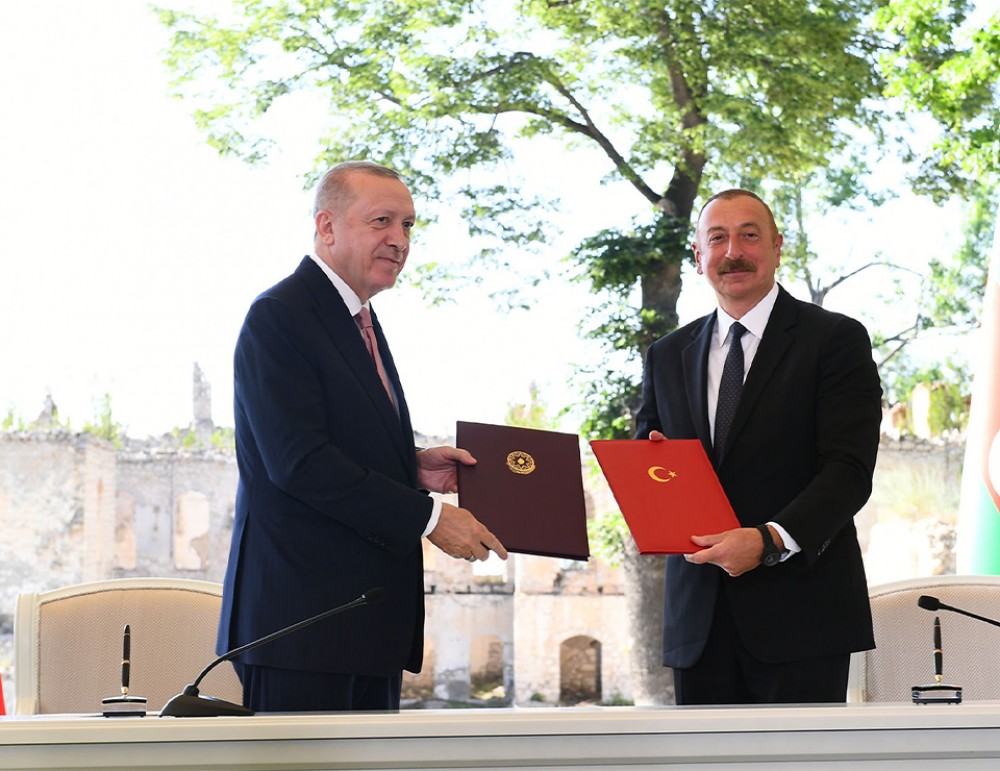
On June 15, 2021, the Shusha Declaration, signed by the presidents of Azerbaijan and Turkey in Shusha, officially marked a new phase of alliance formation between Ankara and Baku. 

Over the past 30 years, relations between the two countries have focused on eliminating the consequences of invasion and aggression against Azerbaijan in the early years of its independence. Consequently, this led to the development of a deeper military-to-military cooperation within the evolving strategic partnership. The bilateral military cooperation should be seen in the context of the Turkish Armed Forces’ significant contribution to the training-tactical preparation and financial-technological advancement of Azerbaijani army. 

Azerbaijan's military victory in the Second Karabakh War meant achieving the objectives of the Azerbaijani-Turkish military cooperation. The liberated city of Shusha is also the most visible product of bilateral military partnership over the past 30 years. In my opinion, the choice of Shusha as the place to sign the new agreement is a political message that the previous stage has been sufficiently successful. 

In the new post-war geopolitical conjuncture, there was an immediate need to redirect the energy of bilateral cooperation, which had a military character and mainly focused on the "Karabakh issue." In this regard, in their speeches, both leaders emphasized the end of the military phase of the conflict and insisted the new phase would focus mainly on regional and economic cooperation.

The Shusha Declaration can also be considered as the first prestigious step in the evolution of the Azerbaijani-Turkish alliance from the Karabakh dimension into a military-political bloc that can focus on regional issues.  

Related work

Expert opinion

US foreign policy before midterm election

As the US midterm election is approaching, the correlation between President Trump’s statements and actual US policies, gets more and more uncertain. And while his occasional eccentricities on Twitter or during rallies with supporters, have become part of a po...

Murad Muradov, 27 October 2026

Expert opinion

Connecting Central Asia and the South Caucasus

On November 15, Azerbaijan formally joined the Central Asian Consultative Meetings, expanding what was known as the Central Asian Five (C5) into a Central Asian Six (C6). Many in Central Asia find it surprising. But when viewed through the lens of recent geopo...

Gulkhanim Mammadova, 1 December 2025

Expert opinion

Azerbaijan joins the C5: implications for Eurasian regional architecture

When the long-standing C5 format of Central Asian cooperation formally expanded into a C6 on 15 November in Tashkent, Azerbaijan’s accession was framed as a natural extension of historical and linguistic affinities. Yet behind the rhetoric lies a structural tr...

Gulkhanim Mammadova, 21 November 2025

Expert opinion

Kazakhstan joins the Abraham Accords: Pragmatism or Symbolism?

Kazakhstan’s accession to the Abraham Accords—anticipated in some political circles—may still raise eyebrows. Unlike the original signatories, who were establishing relations with Israel from scratch, Kazakhstan has long maintained cordial ties with the Jewish...

Rusif Huseynov, 9 November 2025

Expert opinion

13 June attack: quick comments

In the most extensive attack on Iran since the country’s 1980-88 war with Iraq, Israeli forces have launched multiple waves of nationwide bombings. The attack is ongoing and believed to be the opening shots of a wider campaign to degrade Iran’s military comman...

Murad Muradov, 13 June 2025

Expert opinion

Historic First in Tbilisi: Armenia, Azerbaijan and Georgia trilateral talks

On April 17, Tbilisi hosted the first-ever formal trilateral meeting between the foreign ministries of Armenia, Azerbaijan and Georgia. According to official statements, the primary aim of the meeting was to create a platform for open dialogue and to explore p...

Gulkhanim Mammadova, 17 April 2025

Expert opinion

Munich speech, 18 years later

The Munich speech of the U.S. Vice President J. D. Vance will definitely enter the textbooks of the future as one of the harbingers of a new historic period. This speech has been arguably more shocking than Vladimir Putin’s diatribe he made on the same stage 1...

Murad Muradov, 19 February 2025