

The Mecca Pact and the Architecture of Autonomous Deterrence
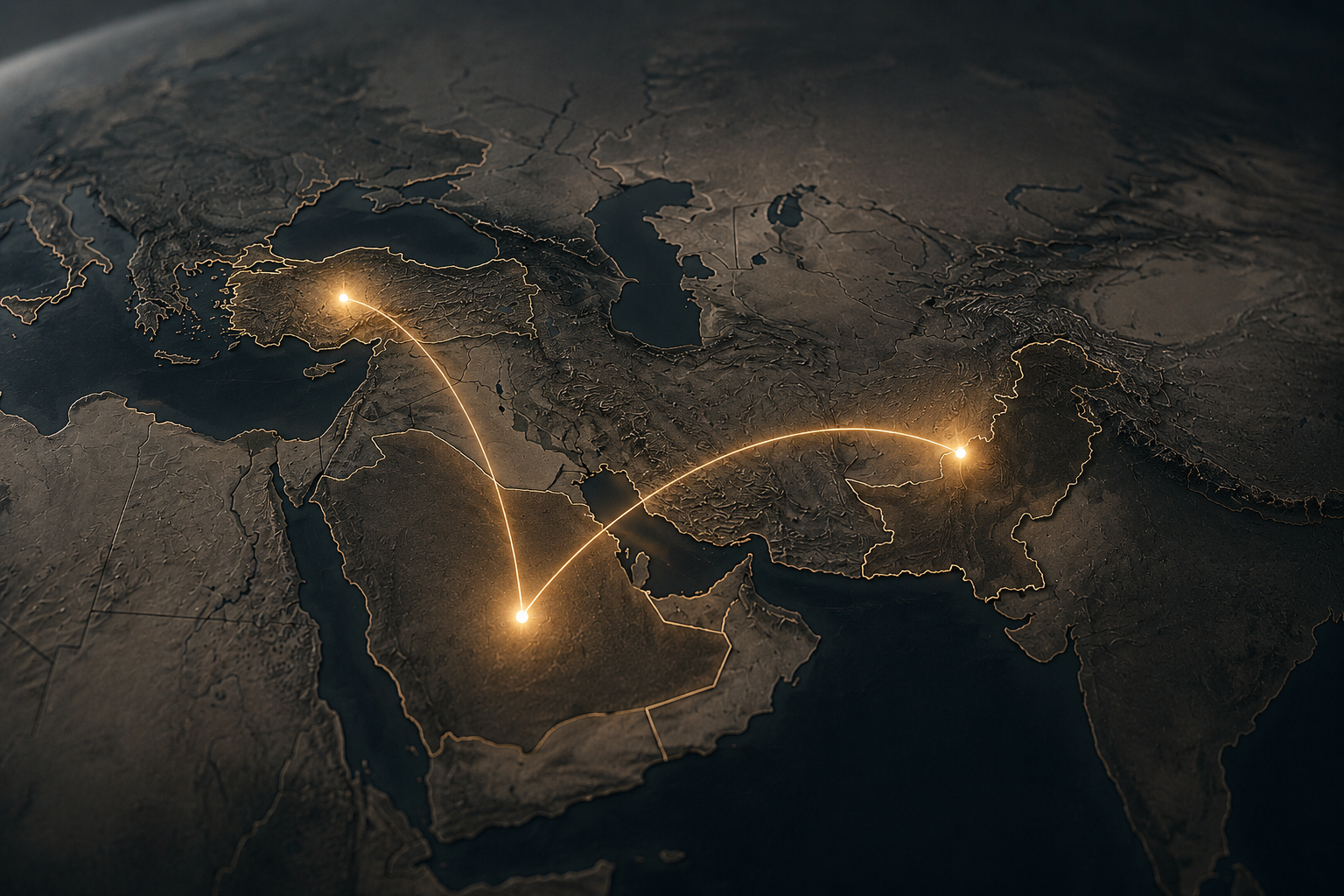
On 7 August 2026, Saudi Arabia, Türkiye, and Pakistan signed the Mecca Joint Defence Agreement in Mecca, as attacks on Gulf infrastructure and wider regional tensions continued to put pressure on Saudi Arabia’s security strategy. The agreement establishes a collective defence commitment between three major military powers whose capabilities and strategic interests differ considerably. Grounded in the right of self-defence under Article 51 of the United Nations Charter, it provides that an armed attack against one signatory will be treated as an attack against three.
Turkish Foreign Minister Hakan Fidan has described this provision as functionally comparable to NATO’s Article 5, while the agreement also establishes joint military and political committees to coordinate cooperation between the three states.
By bringing together Saudi financial resources, Türkiye’s defence industrial capabilities, and Pakistan’s military capacity, the Mecca agreement creates a new layer of security cooperation with implications that extend beyond its three signatories.
For Saudi Arabia, the agreement comes at a time when its economic ambitions and security concerns are becoming increasingly difficult to separate. Vision 2030 depends on sustained foreign investment, the development of large-scale projects along the Red Sea coast, and reliable access to the maritime routes that connect the Kingdom to global markets. Yet, attacks on energy infrastructure and disruptions to commercial shipping have shown how quickly regional conflicts can affect these priorities. The issue for Riyadh is therefore not simply how to protect individual facilities, but how to create a security environment in which long term economic development can continue without leaving the Kingdom vulnerable to conflicts taking place beyond its borders. This leaves Saudi Arabia in a difficult seat: it needs a stronger deterrent and greater protection for its infrastructure while simultaneously avoiding a wider confrontation with Iran that could undermine the economic stability on which Vision 2030 depends.
The Mecca Agreement can be understood as a part of Saudi Arabia’s response to this dilemma. Riyadh has spent the past several years broadening its relationships with major regional and international powers, rather than relying on the United States as its only significant security partner. This does not mean that the Kingdom is abandoning Washington. Instead, it reflects an effort to have more options when responding to changes in the regional security environment. Türkiye and Pakistan offer different forms of military and strategic support:
Türkiye has developed a significant defence industry and growing capabilities in areas such as drones and aerospace, while Pakistan brings considerable military experience and a longstanding defence relationship with Saudi Arabia. Bringing these capabilities into a more formal framework gives Riyadh additional security partnerships without necessarily requiring it to replace its existing ones.
This approach also creates a problem of perception. Saudi Arabia has an interest in presenting the agreement as defensive and as part of its effort to protect its territory and economic development. But the way the Kingdom understands the agreement is not necessarily the way its rivals will understand it. For Iran, a closer Saudi relationship with Türkiye and Pakistan could be seen as part of a broader effort to strengthen Riyadh’s position against Tehran. Israel, meanwhile, has an interest in how Saudi’s expanding defence relationships affect the longer-term regional balance, particularly as Riyadh’s relationship with Washington and its position toward Israel continue to evolve.
This is where the security dilemma becomes important. As Jervis (1978) argues, measures taken by one state to improve its own security can make other states feel less secure, particularly when it is difficult to distinguish between defensive and offensive capabilities. From Riyadh’s perspective, the Mecca Agreement raises the potential cost of an attack by making clear that Saudi Arabia would not necessarily respond alone. From Tehran’s perspective, however, the same agreement could suggest that Saudi Arabia is becoming part of a broader network of military partnerships that could constrain Iranian influence. The result is a familiar tension: measures intended to strengthen deterrence can also encourage other states to adjust their own military and diplomatic strategies. The agreement therefore matters for more than the immediate defence commitments between Saudi Arabia, Türkiye, and Pakistan. It forms part of a broader change in the way Riyadh approaches security. Saudi Arabia is trying to protect the economic transformation at the centre of Vision 2030 while operating in a region where existing security arrangements have repeatedly been tested. Building additional defence partnerships gives the Kingdom greater flexibility and could strengthen its position in dealings with Iran, Israel, and the United States. At the same time, a more diversified Saudi security network could encourage other states to respond by strengthening their own partnerships and military capabilities.
Safeguarding Vision 2030
Saudi Arabia’s current foreign and security policy is closely tied to Crown Prince Mohammed bin Salman’s Vision 2030, which aims to reduce the Kingdom’s dependence on oil and build a more diversified economy based on investment, technology, tourism, and logistics. Much of this transformation depends on attracting foreign capital and creating the conditions for large-scale projects to develop, particularly along the Red Sea coast. Security is therefore not separate from the economic agenda. It is one of the conditions on which the success of Vision 2030 depends. This has encouraged Riyadh to reduce its exposure to the traditional energy routes through the Gulf. The Strait of Hormuz remains a major vulnerability during periods of regional conflict, since a significant share of Saudi oil exports and other commercial traffic has historically passed through the Persian Gulf. Saudi Arabia has consequently invested heavily in alternative routes that can move energy toward the Red Sea. A central part of this effort has been the expansion of the 1200-km East-West Pipeline, which carries crude from the Eastern Province to Red Sea export terminals at Yanbu, alongside the development of refining capacity such as the 400,000-barrel-per-day Jazan refining complex. The purpose is straightforward: reducing reliance on a single maritime route gives Saudi Arabia greater flexibility when tensions in the Gulf threaten energy exports.
Recent attacks, however, have exposed the limits of this approach. The shift toward the Red Sea reduces Saudi Arabia’s dependence on the Strait of Hormuz, but it does not remove its exposure to regional conflict. Strikes on Saudi energy infrastructure, including Aramco’s Jazan refinery and facilities in Yanbu, have shown that infrastructure located farther from the main Gulf flashpoints can still be reached by long-range drones and other forms of aerial attack. In other words, moving energy infrastructure toward the Red Sea has changed the geography of Saudi Arabia’s vulnerability rather than eliminated it. This distinction matters for Vision 2030. The Kingdom can diversify its energy routes, expand its infrastructure, and move major economic projects away from traditional areas of exposure, but these measures cannot fully protect them if the wider security environment remains unstable. Repeated attacks can disrupt operations and create uncertainty for companies and investors, while instability around Red Sea shipping routes can increase the costs and risks associated with commercial activity. More importantly, the continued vulnerability of critical infrastructure creates a broader strategic problem for Riyadh: responding to every attack through defensive measures or retaliation risks drawing Saudi Arabia back into the kind of sustained regional confrontation it has spent recent years trying to avoid.
This is where the security dimension of Vision 2030 becomes particularly important. Infrastructure diversification can reduce one type of vulnerability, but it cannot replace deterrence. Air-defence systems and post-strike repairs can limit the immediate damage caused by attacks, yet they do not necessarily prevent an adversary from launching another one. For Saudi policy-makers, the question is therefore increasingly about how to make the cost of attacking critical infrastructure high enough to discourage future strikes, rather than simply how to absorb the damage when they occur. The Mecca Joint Defence Agreement can be understood within this broader shift. Rather than treating economic development and defence policy as separate priorities, Riyadh is increasingly linking the security of its economic transformation to the strength of its external partnerships.
The agreement with Türkiye, a NATO member with a growing defence industry, and Pakistan, a major military power with nuclear capabilities, gives Saudi Arabia additional military relationships that could strengthen its ability to deter attacks. The value of the agreement therefore lies not only in the forces that the three countries could potentially deploy, but also in the signal it sends to potential adversaries: an attack on Saudi infrastructure could carry consequences beyond a bilateral confrontation with Riyadh.
The Mecca Agreement consequently adds a military dimension to Saudi Arabia’s broader effort to protect Vision 2030. Riyadh’s strategy is no longer simply about moving infrastructure away from vulnerable routes; it is also about making the infrastructure itself harder to threaten. Whether the new defence arrangement succeeds in strengthening deterrence will depend on how credible the collective response is in practice, and on whether regional actors believe that an attack on Saudi territory could genuinely trigger a coordinated response from its partners.
Strategic Media Discourse
Saudi Arabia’s media messaging following the signing of the Mecca Joint Defence Agreement suggests that Riyadh is trying to achieve two things at once: make the agreement credible as a deterrent while avoiding language that could unnecessarily escalate tensions with regional rivals or unsettle international markets. Its approach extends beyond formal government statements. Saudi-aligned media outlets such as Asharq Al-Awsat and Arab News, together with commentary from influential Saudi figures on X, have provided different channels through which Riyadh can explain the purpose of the agreement, emphasise its defensive character, and communicate how it fits into the Kingdom’s broader security strategy. In domestic coverage, the agreement is largely presented as a means of strengthening Saudi Arabia’s ability to protect itself rather than as the formation of an alliance directed against a particular state. In an interview with Asharq Al-Awsat, Turkish President Recep Tayyip Erdoğan described the treaty as one that “boosts deterrence” while stressing that it was not aimed at any specific country. This distinction is important for Riyadh. The Kingdom wants potential adversaries to take the new defence commitment seriously, but it also wants to avoid presenting the agreement as the beginning of a new regional military bloc. Coverage that focuses on defence cooperation, technology, and naval capabilities similarly connects the pact to Saudi Arabia’s longer-term efforts to strengthen its military capabilities and protect the infrastructure supporting Vision 2030. Moreover, publications such as Arab News add another layer of intricacy by placing greater emphasis on the agreement’s legal basis, particularly its reference to Article 51 of the UN Charter, and on its stated defensive purpose. The agreement has also been presented as non-sectarian and potentially open to cooperation with other regional partners. This framing is relevant not only to Saudi Arabia’s foreign-policy relationships but also to how the agreement is viewed by investors and international businesses whose interests depend on the security of Saudi infrastructure and Red Sea shipping. By emphasising international law and collective defence rather than confrontation, Riyadh can present the agreement as a response to an unstable security environment without openly framing it as part of a broader confrontation with Iran.
The most clear form of messaging has come through prominent Saudi commentators. Unlike official statements, these voices have more room to discuss the broader strategic reasoning behind the pact. Analysts close to Saudi decision-makers, including Ali Shihabi, have framed the agreement as a response to a changing regional environment in which Saudi Arabia can no longer assume that external powers will always provide the security it needs. The argument is not necessarily that the United States has withdrawn from the region, but that regional states increasingly have to take greater responsibility for managing threats closer to home. A similar argument appears in the commentary of Dr. Abdulaziz Sager, Chairman of the Gulf Research Center, who has emphasised the political significance of bringing Saudi Arabia, Türkiye, and Pakistan into a single defence framework at a time of considerable uncertainty across the region. More importantly, he argues that the agreement’s significance will depend on whether it develops beyond a political commitment into sustained military cooperation. If the three states build the institutions and capabilities needed to make the arrangement work in practice, the pact could give them considerably greater collective weight and contribute to a security framework that relies more heavily on regional powers themselves.
At the same time, official messaging has been careful to place boundaries around this interpretation. Saudi officials and diplomats, including Deputy Minister for Public Diplomacy Rayed Krimly, have stressed that the agreement is defensive, open to other regional partners, and not intended to create a sectarian bloc or an aggressive military axis. This distinction matters because Riyadh is trying to strengthen deterrence without locking itself into an openly confrontational position toward Iran or other regional actors. Taken together, these different forms of messaging allow Riyadh to communicate several things at once. Official statements emphasise restraint and legality, while commentary from influential Saudi figures is able to speak more directly about the changing regional balance and the need for greater regional responsibility for security. The result is a deliberate degree of ambiguity: the agreement is presented strongly enough to signal that Saudi Arabia has greater military backing, but cautiously enough to preserve space for diplomacy and avoid defining the new partnership around a single adversary.
Regional Friction & Strategic Realignments
The Mecca Joint Defence Agreement strengthens Saudi Arabia’s deterrence, but it also raises questions about how the new arrangement will affect existing relationships across the region. Rather than creating a unified security bloc, the agreement may expose some of the different priorities that already exist among Gulf states and their regional partners. Its implications therefore extend beyond the military relationship between Saudi Arabia, Türkiye, and Pakistan.
Moreover, the decision not to include Egypt in the initial agreement points to a more selective approach to Saudi alliance-building. Despite efforts from Ankara to bring Cairo into the arrangement, Saudi Arabia resisted Egypt’s immediate inclusion. The reasons reportedly included concerns about Egypt’s economic difficulties and questions over the extent to which its military-industrial capacity could contribute to the kind of defence cooperation Riyadh was seeking. Whether or not these considerations prove decisive in the longer term, Egypt’s exclusion is significant because it suggests that Riyadh was not simply trying to recreate an older Arab security arrangement. Instead, it appears to have prioritised partners that could provide specific military or technological capabilities and that were able to contribute to a more focused defence structure.
The Mecca agreement also has implications for Saudi Arabia’s relationship with the United States. Its creation does not necessarily signal that Riyadh is moving away from Washington. Instead, it gives Saudi Arabia another source of security support and potentially strengthens its position when negotiating the terms of its relationship with the United States.
Washington can remain an important security partner without being the only source of military reassurance available to Riyadh. In this sense, the agreement reflects a broader effort by Saudi Arabia to take on a greater share of responsibility for its own security while maintaining its existing ties with the US. The same logic matters for Saudi Arabia’s relationship with Israel. A stronger Saudi security network could give Riyadh greater freedom in deciding whether and on what terms to pursue future normalisation with Tel Aviv. If Saudi Arabia has additional security guarantees from Türkiye and Pakistan, the urgency to seek security concessions from Israel as part of a normalisation agreement may be reduced. This could give Riyadh more room to make normalisation conditional on issues that matter to it politically, particularly the question of Palestinian statehood, rather than approaching the relationship primarily through the lens of its own security needs.
Iranian and Israeli Pushback
While the Mecca Joint Defence Agreement is presented by its signatories as a defensive arrangement, its creation also illustrates the security dilemma described by Jervis (1978). Measures that one state takes to make itself more secure can make neighbouring states feel less secure, particularly when it is difficult to distinguish between defensive and offensive capabilities. For Saudi Arabia, bringing Turkish defence capabilities and Pakistani military capacity into a formal security arrangement strengthens its ability to deter future attacks. For Iran and Israel, however, the same development changes the regional balance and creates new questions about the military capabilities that could eventually be directed against them.
Iran’s initial public response has been relatively restrained. Iranian officials and state media have maintained that Tehran is essentially unphased by the new Mecca Joint Defence Agreement, presenting the pact less as an anti-Iranian coalition than as evidence that regional states are becoming less confident in the existing US security framework. Foreign Ministry officials have argued that Saudi Arabia’s decision reflects a growing recognition that Washington cannot be expected to provide unlimited security guarantees. The discussion within Iran, however, has been more critical. Commentary in outlets such as Donya-e-Eqtesad and Cafe Diplomat has treated the agreement as evidence of a changing regional security environment and, in some cases, as a form of pressure on Iran. More critical assessments from Iranian diplomats, including former UN Ambassador Kourosh Ahmadi, have also raised questions about whether Iran’s own regional strategy contributed to this outcome. From this perspective, the repeated use of proxy attacks and pressure on Gulf energy infrastructure may have produced an unintended result: instead of discouraging Saudi Arabia from pursuing a stronger security relationship with external partners, they encouraged Riyadh to seek more formal and binding defence commitments. The response from within Iran is therefore important because it shows how the security dilemma can become self-reinforcing. If Tehran views the Mecca Agreement as a response to Iranian pressure, it may conclude that stronger counter-measures are necessary. This can already be seen in debates over the Strait of Hormuz, where more conservative members of the Iranian parliament have pushed for greater government control over the waterway. Whether such measures are ultimately adopted or not, the discussion illustrates the broader problem: steps taken by one side to improve its position can lead the other side to strengthen its own, making the regional environment more difficult to manage.
Israel presents a different but equally important case.
Riyadh and Tel Aviv share an interest in limiting Iranian influence, but the Mecca Agreement introduces elements that may complicate Israel’s assessment of the emerging security balance. Türkiye’s participation is particularly significant given the deterioration in Turkish-Israeli relations, while Pakistan’s involvement adds another major military actor to the arrangement.
Israel therefore has reason to pay attention to the possibility that closer Saudi-Turkish defence cooperation could eventually lead to greater technology transfers, joint production, or cooperation in areas such as aerospace and missile defence. Moreover, the agreement may also change the terms of Saudi-Israeli diplomacy. Before the pact, one argument in favour of normalisation was that Saudi Arabia’s exposure to Iranian attacks created a strong incentive for Riyadh to seek additional security guarantees from Washington and, indirectly, from Israel. The Mecca Agreement does not remove that incentive entirely, but it gives Saudi Arabia another source of security support and therefore reduces its dependence on any single arrangement. This could strengthen Riyadh’s negotiating position if normalisation talks resume, particularly on issues such as Palestinian statehood and the political concessions Saudi Arabia would seek in return for recognising Israel.
Strategic Outlook
The Mecca Agreement points to a broader change in the regional balance of power. Its significance is not simply that Saudi Arabia is building new security partnerships as the US role in the region becomes less certain. More importantly, it shows how regional states are beginning to take a greater role in shaping the security arrangements around them. The result is unlikely to be a single new alliance system replacing the old one. Instead, the region may develop a more complicated network of partnerships in which states cooperate in some areas while competing in others. In addition to this, middle powers are consequently becoming more important to the way security is organised in the region.
Saudi Arabia, Türkiye, and Pakistan are not simply looking to existing powers for protection; they are using their own resources and capabilities to build a security arrangement around specific interests. If the arrangement develops into sustained military cooperation, it could give its members greater ability to respond to regional threats without relying entirely on an external security provider.
There is, however, a cost to this growing reliance on regional coalitions. A system built around several overlapping partnerships can give states greater flexibility, but it can also make the regional balance harder to read. The more states develop security relationships that are designed to deter one another, the greater the possibility that defensive measures will be interpreted as preparations for confrontation. This is particularly relevant in a region where tensions between Iran, Israel, and the Gulf states can escalate quickly and where military capabilities are increasingly distributed among several actors. The durability of the Mecca arrangement will therefore depend on more than the military capabilities of its three members. Its long-term value will depend on whether Saudi Arabia, Türkiye, and Pakistan can turn the agreement into a credible source of deterrence without allowing it to become defined by confrontation with a particular rival. Maintaining channels of communication with neighbouring states will be just as important as building military capabilities. If the agreement remains focused on protecting its members and their economic interests, it could become a useful part of a more diverse regional security system. If it instead becomes one side of a wider competition between rival blocs, it could reinforce the very insecurity it was created to address.