

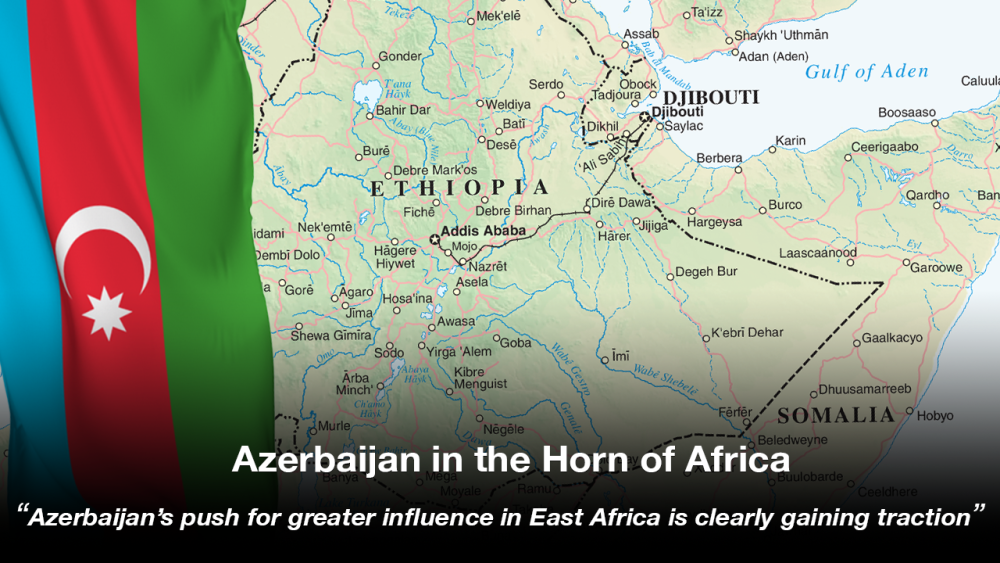

"Azerbaijan’s push for greater influence in East Africa is clearly gaining traction."
Over the past decade Azerbaijan has become an increasingly active regional actor. While its recent attention has primarily been directed toward Europe and the Middle East, with a particular emphasis on the Gulf states, Azerbaijan has also significantly expanded its presence in the Horn of Africa since 2011. This expansion is especially evident in its growing involvement in Djibouti, Ethiopia and Somalia.
Azerbaijan's initial approach to engaging with Africa relied on soft power, primarily through humanitarian aid, educational programs, and cultural initiatives. Over time, its strategy has evolved to include more assertive forms of engagement, positioning Baku as a visible and increasingly influential actor in the region..
To broaden its reach, Azerbaijan has cultivated relationships with a wide range of stakeholders, including governmental bodies, private sector actors, and faith-based organizations. One key avenue has been educational diplomacy: Baku has offered academic opportunities to students from Djibouti, Ethiopia, and Somalia, enabling them to pursue degrees in Azerbaijani universities in fields such as engineering, medicine, and international relations.
Similar to Ankara, Baku prioritizes state sovereignty and avoids imposing political conditions on its partners. In this regard, Azerbaijan’s Muslim identity and lack of a colonial past serve as distinct advantages. For many African nations, Azerbaijan’s aid model is particularly appealing. While its financial assistance may be limited, the direct, bilaterally negotiated grants offer a compelling alternative to aid from international institutions, which often come with significant political conditions.
Recent developments underscore this growing partnership. In February 2025, Azerbaijan and Somalia signed several agreements to enhance bilateral cooperation in energy, defence, education and public services. Azerbaijan's President, Ilham Aliyev, also discussed the possibility of jointly manufacturing defence equipment and supplying defence materials from Azerbaijan to Somalia.
Baku is also keen to strengthen its bilateral relations with Djibouti through diplomatic engagements, parliamentary cooperation, and agreements aimed at enhancing economic and technical collaboration. Azerbaijan already has a bilateral intergovernmental agreement on cooperation in civil aviation with Djibouti. This agreement has facilitated regular passenger and cargo transportation between the two countries, aiming to boost economic and cultural relations.
Engagement with Ethiopia has followed a similar trajectory. In December 2024, a cooperation agreement was signed between Ethiopia's Dire Dawa Free Trade Zone and Azerbaijan's Alat Free Trade Zone. Both countries have also expressed interest in collaborating on agricultural development.
The timing of these agreements is crucial, as the Horn of Africa, situated at the crossroads of global trade routes and rich in strategic opportunities, has become a focal point for competition among both global and regional powers. Azerbaijan's active involvement in this region boosts its position not only in Africa but also on the global stage, showcasing its ability to achieve tangible results in areas where traditional powers have struggled to make progress.
However, Baku's increasing assertiveness in the Horn of Africa faces significant challenges. For regional powers like Egypt, the region is a critical battleground in its longstanding rivalry with Ethiopia, largely driven by disputes over the Grand Ethiopian Renaissance Dam. In response, Cairo has sought to forge closer ties with Somalia and other nations in the region, aiming to diplomatically isolate Addis Ababa and counter Ethiopia’s growing influence. Against this backdrop, Egypt may view Baku’s growing presence in the region with wariness, particularly as Azerbaijan’s key ally, Türkiye, strengthens its relations with both Ethiopia and Somalia.
Baku cannot overlook the tensions between Ethiopia and Eritrea as well. Two years after the devastating war in Ethiopia’s Tigray region, internal conflicts and rising friction between Addis Ababa and Asmara risk reigniting hostilities. Fortunately, there is still an opportunity for diplomacy to mitigate these risks.
Azerbaijan must also engage with Eritrea, as the lack of interaction became evident when it took months to secure the release of 18 Azerbaijani citizens. This followed the detention of three Azerbaijani-flagged vessels and their crews by Eritrea after they entered its territorial waters. The delayed release of Azerbaijani citizens underscores the need for stronger engagement and communication between the two nations.
Looking ahead, Azerbaijan’s influence in the Horn of Africa is set to evolve as it navigates the intricate dynamics of regional geopolitics. As the region’s economic potential grows and its security challenges persist, Azerbaijan faces a critical challenge in advancing its strategic objectives in the Horn of Africa while ensuring it does not escalate tensions with regional powers.
Azerbaijan must ensure that its engagement remains sustainable and is perceived positively by the nations it aims to influence. This requires ongoing investment in infrastructure, development, and humanitarian initiatives to strengthen its role as a constructive partner. How Baku navigates its engagement with the Horn of Africa will have profound implications, not only for the region but also for Azerbaijan’s broader geopolitical ambitions on the African continent.