

C5 switches to C6: views from Central Asia
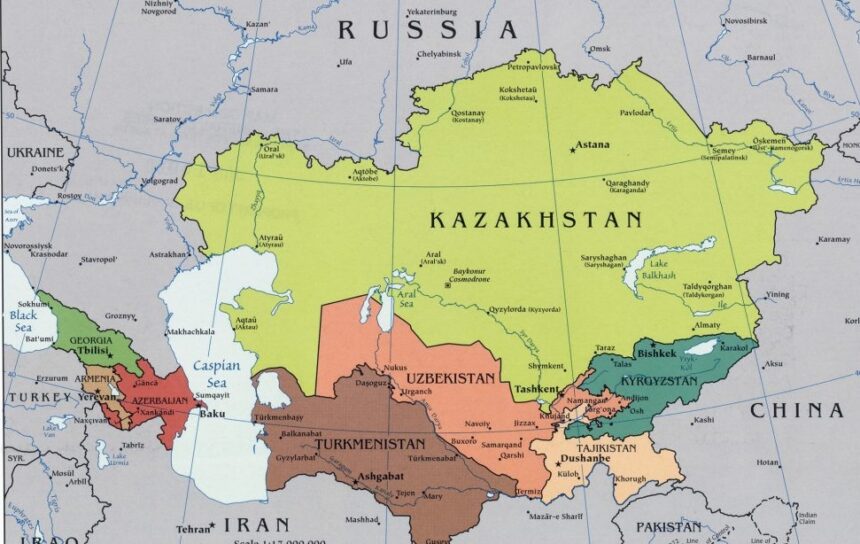
Since the beginning of the second decade of the XXI century, Central Asia started to form a common agenda and shared positions on logistics, transportation, energy, security and foreign policy. The C5 format, which traditionally unites five Central Asian countries, has been gradually transforming from a consultation platform to discuss minor issues into an instrument for regional positioning, with prospects for becoming a full-fledged union in the future. In this framework, the role of Azerbaijan, geographically located in the South Caucasus while in fact being pivotal for the Caspian-South Caucasus-Europe route, has been expanding. For Kazakhstan, the key player in the Central Asian region, Azerbaijan’s participation in C6 format is not coincidental: Astana consistently promotes the idea of Caspian cooperation and development of transcontinental transport corridors as well as multilateral diplomacy, in which the region is not a target of great power rivalry but rather shapes its own agenda.
In order to understand the context on this process and Kazakhstan’s view, it is important to highlight that Azerbaijan recently has become a crucial strategic partner for Astana: in the last five years, Kazakhstan’s President Kassym-Zhomart Tokayev and Azerbaijan’s President Ilham Aliyev have held at least five mutual governmental visits only in the context of bilateral relations. The intensity of the development of the two countries’s relations is noticeable: joint military trainings together with other Turkic states, progress in terms of trade and increased importance of the Middle Corridor in the context of geopolitical tensions in the world are bonding interests of both countries, enlarging their perspectives for future cooperation.. Alongside with the enhanced importance of the Organization of Turkic States, which has a earned new status with its initial positioning as Turkic Council until the 8th Summit of OTS in Istanbul at 2021, as well as President Tokayev’s congratulations to Azerbaijan over the restoration of territorial integrity, these factors have definitely taken Kazakhstan and Azerbaijan’s bilateral relations to a relatively high level, and now the two countries are committed to start a new era of cooperation and mutual development thanks to Azerbaijan’s re-orientation as a subject to Central Asia’s regionalistic agenda. Building upon its strengthening ties with Kazakhstan as well as with other Central Asian countries, as well as the shared interest in better multisector interconnectivity, at the 7th Consultative Meeting in Tashkent in November 2025 Azerbaijan joined the Consultative Meeting of Heads of State of Central Asia as a full participant, becoming the first country geographically located out of the Central Asian region to be included in this high-level regional forum.
Does it mean that Azerbaijan would be considered part of Central Asia? The short answer would be “no” from both Azerbaijani and Kazakhstani sides, since joining this platform does not necessarily imply that Baku’s status from the perspective of geographical regionalism will completely change with its alignment to the C6. Kazakhstan traditionally operates a variety of agreements and joint platforms from a pragmatic approach, and, in the current global situation, Azerbaijan is being perceived as a highly strategic partner. At the same time, Central Asian countries were trying to build their regional mechanism for decades right after the collapse of the Soviet Union, and the majority of relevant discussions were initiated by Nursultan Nazarbayev, the first President of Kazakhstan, but the format he was proposing never materialized. This process developed naturally, starting out from the meeting of all Central Asian countries with Japan in 2004. Right now, the structure of the C6 with a new member will be multilayered, whereas Azerbaijan is considered a natural ally, a brother country in terms of its Turkic and post-Soviet background, an OTS member, and now also a participant in Central Asian affairs within the C6. In Astana, there is certain awareness that Azerbaijan will not actively participate in all the discussion within C6, and geographical difference still matters; it is expected that Baku’s role will focus on those subjects where Azerbaijan’s position is important, and mutual interests dominate over the differences.
Kazakhstan positively perceives the alignment of Azerbaijan to the C5 platform, mainly due to the expanded opportunities in terms of infrastructure and logistics.
Astana needs more alternatives in terms of logistics to European countries, as well as the global market in general, and, taking into consideration that trade routes through Iran and Russia at the moment are not accessible due to sanctions and tensions in both countries, Azerbaijan is providing an alternative for the transportation of goods. One of the obstacles in this case would be bandwidth of the Caspian route through Azerbaijan: the port of Alat, despite being a major logistics hub in Eurasia, still needs to enhance its capacity in order to support increased trans-Caspian trade since alternative ports are not able to handle large amounts of goods in their current capacities either. This issue might be overcome through the expansion of hubs in Aktau, Kazakhstan, and shorten the expenditures for transportation to 50%, also with the development of oil exports through the Baku-Tbilisi-Ceyhan (BTC) pipeline.
No less important is the factor of security: Astana and Baku already cooperate in the context of regional security and integration of the Turkic states, as both countries actively participate in developing key areas of cooperation such as joint military exercises and exchange of experience in military training. For example, in 2024, Azerbaijan and Kazakhstan took part in the “Birlestik-2024” exercises, which were the first military training in Central Asia without the participation of extra-regional countries that were previously involved in such activities. In the context of cross-border threats, militarization of adjacent territories, and raising competition between external powers, Baku, which has sufficient military experience and an already modernized army, is increasingly viewed in Astana as a potential partner for strengthening defense dialogue and developing military capacity within the framework of a broader Turkic architecture for the region.
It is important to mention the Turkic factor within the new agreement and Azerbaijan as a new member in the Central Asian platform. Both government and public in Kazakhstan perceive Baku’s increasing exposure to the region positively: both actors are fueled by the idea of Turkic solidarity institutionalized within the OTS, the Turkic Culture and Heritage Foundation, and other initiatives in similar contexts, which clearly signals that Kazakhstan and Azerbaijan have common initiatives to develop the "Turkic world”, and Baku is perceived as part of a wider Turkic ecosystem. It is an ideologically neutral but symbolically significant factor that gives hope to include Azerbaijan into a long-term strategy of diversifying external relations, strengthening the Middle Corridor, and forming an autonomous Eurasian entity. However, it would be a mistake to overexaggerate the Turkic element behind “C5+1”: both countries are known for their multicultural policies, and in this regard their cooperation is viewed primarily through the pragmatic lens rather than an ideological one.
However, as Kazakh political analyst and Head of Research at Nightingale, Eldaniz Gusseinov notes, an asymmetry in mutual perception still holds. As he argues, “Azerbaijan has known Central Asia for 30–35 years, but Central Asia does not really know Azerbaijan”. In many Central Asian discussions, Baku may still be perceived, according to Gusseinov, as a country grappling with the “Karabakh syndrome”, where Azerbaijan’s image is narrowed primarily to the conflict agenda, and expert dialogue sometimes involves misunderstandings: “The dialogue is being constructed with difficulties; there is an impact of recent success of Azerbaijan in Second Karabakh war in the Azerbaijani expert field since they were focusing on this issue and were less prone to learn from Central Asian colleagues regarding their opinions on other issues”. He also emphasizes that Azerbaijan occasionally promotes narratives contradictory to the Central Asian priorities, "for instance regarding the issue of Northern Cyprus or public speeches from the Azerbaijani officials that there would be discussions on the highest level about expanding military cooperation with a potential of making a union with Central Asia, which are not particularly interesting for the region”.
Moreover, as he underlines, “Azerbaijan associates itself more with the South Caucasus, while for Central Asia clarity of positioning is very important”, which raises certain regional scepticism from Central Asian countries, including Kazakhstan, towards Baku.
The obvious issue highlighted by the expert is the “lack of precise obligations and bureaucratic procedures within the organization”, which must be conducted in matters like expansion of the C5 platform into the C6, casting doubt over the clarity of procedures within the organization.
On the other hand, Umed Khakimov, an independent expert from Tajikistan, offers a more pragmatic and accurately optimistic evaluation from Dushanbe’s perspective. Initially, the expert highlights that “the C5+1 format has strengthened Tajikistan’s foreign policy positioning by enhancing political dialogue with global powers, providing access to climate, energy, and security programs, and creating additional opportunities for investment and infrastructure development, while also reinforcing Central Asia’s regional identity as an increasingly coherent international actor”. In the context of Azerbaijan’s participation in this framework, he argues that "in Tajikistan Azerbaijan is still perceived more as an external actor, but at the same time as a state with steadily growing potential for meaningful partnership”. Following these dynamics, Mr. Khakimov states that the “inclusion of Baku in the C6+1 framework is viewed by parts of the Tajik expert community as a logical and functionally justified expansion rather than a geopolitical shift”.
He emphasizes: “Azerbaijan’s value lies in strengthening Central Asia’s connectivity, especially through access to the Caspian route, energy corridors and as a transit subject towards Türkiye and Europe”.
Meanwhile, he notes a “degree of caution” in the Dushanbe policy circles still exists; it is believed that with Azerbaijan’s decision to join the platform Central Asia’s identity should remain a distinct geopolitical entity. Even though Tajikistan is interested in the expansion of the format out of the Central Asian geography, the participation of new actors must stay strictly pragmatic, delivering precise, material outcomes in transport infrastructure, energy cooperation, and investment flows. Mr Khakimov also provides specific examples of potential “drivers of trade”, which include “Tajik exports of aluminum and other metals, agricultural products such as dried and fresh fruits, cotton, as well as exports of pharmaceuticals and textiles, while Azerbaijan can offer expertise in energy technologies and petrochemicals”.
Following the opinion of the experts and analyzing all the factors, it is possible to highlight that the evolution from C5 to C6 does not represent a redefinition of Central Asian geographical boundaries; however, it boosts regional cooperation and switches the agenda towards a more pragmatic approach, which is particularly important for Kazakhstan in the current geopolitical turbulence. Even though Astana does not perceive Baku as a new Central Asian country, it indeed views Azerbaijan as a strategic partner, potentially crucial when it comes to connectivity, logistics, energy diversification, and at the same time an important ally for all the Caspian-related issues.
Robust bilateral relations built between Tokayev and Aliyev over the recent years prove that this alignment is not merely a series of symbolic acts deriving from cultural and historical bonds, but rather a cooperation based on mutual interests in a wide variety of areas. It also builds foundations for future relations, which are being shaped by strategic calculations and right assumptions from both sides. The rising role of the Organization of Turkic States and significance of the Middle Corridor in the current agenda are providing both institutional and infrastructural fundamentals for this enlargement. At the same time, the Turkic factor is not primary yet compared to material factors, like economic and logistical incentives, which are mainly driving the process. Moreover, expert opinions from Kazakhstan and Tajikistan are showing that the transition towards C6 is coming with caution. Issues regarding institutional clarity, lack of mutual understanding in certain areas and vulnerabilities regarding the protection of Central Asia’s distinct geopolitical identity are giving an image that the format will most likely be flexible rather than transform into a fully formalized alliance. Eventually, these facts once more lead to a conclusion that the C6 format will become more of an instrument of cooperation on a variety of common issues, such as ecological problems in Caspian Sea, logistical concerns, economic prosperity and benefits of each actor. Kazakhstan’s perspective might be characterized as strategically optimistic, yetbut cautious in terms of institutionality.
Azerbaijan’s accession to this format is perceived more like an opportunity to develop regional autonomy, diversify international relations and cooperation, as well as give more power to the trans-Caspian regionalism without defragmenting Central Asia’s internal integrity.
If operations are managed pragmatically, the C6 may turn into a multi-layered platform which consolidates Central Asia’s position as an independent factor in Eurasia more than it will complicate and discourage it, boosting the region’s aspiration and readiness to a coordinated response to the evolving international order.