


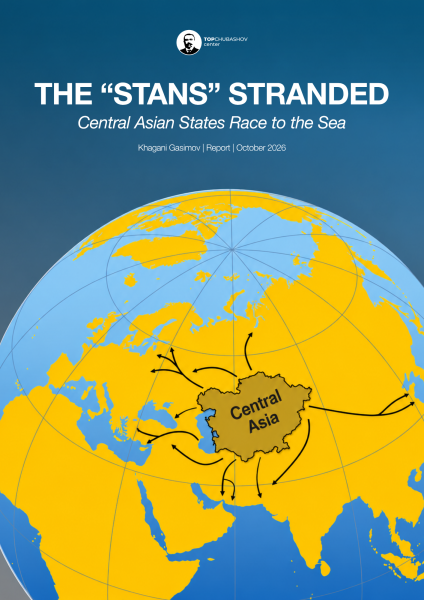


Ukrainian army strikes on Russian cargo vessels in the Black Sea region have disrupted Moscow’s established logistics. Against this backdrop, the Kremlin’s interests in the Middle East are becoming among the hardest hit. Significant declines in exports of grain and other Russian goods to this region are already visible. If the current intensity of Ukrainian attacks in the Black and Azov Seas becomes the norm, Russia will be forced to increase cargo transit through the Caspian Sea and the South Caucasus.
Black Sea instability
The intensity of attacks in the Black and Azov Seas increased significantly in the second half of 2026. According to Ambrey Analytics, between May and October the armed forces of Ukraine and Russia struck 317 civilian vessels in the region. By comparison, 74 ships came under attack during the same period last year. In terms of the damage to Moscow, since July Ukrainian forces have attacked an average of 46 Russian civilian vessels per month.
The heightened risks have significantly reduced the transit of Russian cargo along this route. For example, exports through the port of Novorossiysk have fallen by 44%. Russian grain shipments, which were transported primarily through the Black and Azov Seas, have been hit hardest. From July to October 2026, grain exports along this route fell 4.7-fold compared with the same period last year. Whereas around 71.6% of Russia’s grain exports passed through this region in October 2025, its share amounted to just 5.5% in October this year. Some sources have openly described the situation as a “catastrophe” for Russian agricultural producers.
The problem, of course, is not limited to grain. According to S&P Global, 219,300 tonnes of steel products were shipped through Russia’s Black Sea ports in July, followed by 94,900 tonnes in August (a month-on-month decline of 57%). No shipments through the Black Sea were recorded in September or the first half of October. For the first time in history, exports of diesel fuel and gasoil by this route also fell to zero. In 2025, an average of around 200,000 tonnes per week had been exported through Black Sea ports. A similar situation has unfolded with coal, exports of which from Russia’s Black Sea ports have almost ground to a halt since late summer.
As the Russian business newspaper Kommersant notes, Ukrainian attacks in the Black and Azov Seas have “effectively crossed this basin off Russia’s export logistics map.” The publication offers an even more categorical assessment: in September, cargo traffic through Black and Azov Sea ports fell by 95–100%, while passenger traffic declined by 85%. At the same time, it is worth bearing in mind that a significant share of this cargo was redirected to other routes. According to estimates by the Russian analytical company Infoline-Analytics, between August and October 11.1 million tonnes of cargo were rerouted by rail to the Baltic: 2.7 million tonnes of grain, 2.3 million tonnes of oil cargo, 1.6 million tonnes of thermal coal, 2 million tonnes of metals, and 0.8 million tonnes of fertilisers.
First, such a rerouting significantly lengthens the route and therefore increases transportation costs. Second, sanctions restrict the range of companies able to work with Russian ports and cargo, complicating transit through Europe. Finally, the rapid restructuring of logistics makes it impossible to redirect all cargo. As a result, the Baltic route only partially replaces the lost Black Sea transit, and this has already led to a decline in exports.
Consequences for the Middle East
For Russia, the Middle Eastern direction is becoming one of the areas most severely affected by problems with Black Sea transit. Most countries in the region do not publish detailed customs statistics throughout the year, while Russia stopped doing so after 2022 and the introduction of Western sanctions. Consequently, the full scale of the decline in Russian supplies to the Middle East is not yet clear. Nevertheless, the available information is sufficient to identify significant problems across a number of sectors.
The clearest picture is available for Türkiye. Since 2022, the country has become a key hub for economic cooperation with Russia and has consistently ranked among Russia’s top three largest trading partners, with bilateral trade turnover of $49–68 billion. The Turkish market has remained heavily in surplus for Moscow: Russian exports accounted for 86% of bilateral trade in 2025.
At present, the most serious problems concern grain. In September, Türkiye’s imports of Russian wheat fell by almost 96% year on year, and by 93.5% in October. The problem extends beyond the grain market. In September, Türkiye’s imports of Russian petroleum products fell by 12%, reaching their lowest monthly level since June 2022. Seaborne deliveries of Russian crude oil declined by 59% compared with the previous month, reaching their lowest level since January 2023. Coal supplies fell by 23% in September, to 2.11 million tonnes. Russian experts have also noted a decline in imports of ferrous metals and copper.
According to preliminary data from Turkish customs, Türkiye’s imports from Russia fell by 19.2% between January and October 2026. The decline became more pronounced in the second half of the year: imports fell by 41% in August, 43% in September, and 80% in October. These developments threaten not only Moscow’s interests but also Türkiye’s food and energy security. It is hardly surprising, therefore, that in September Turkish President Recep Tayyip Erdoğan, speaking with his Ukrainian counterpart Volodymyr Zelenskyy, called on both sides to stop attacks in the Black Sea. So far, however, his words have produced no noticeable results.
The data for other countries are less comprehensive. It is known that Russian wheat supplies to Egypt fell by 81% in September and 75% in October. The situation is similar in Saudi Arabia, where wheat imports declined by 57% and barley imports by 74%. There was also a modest 6.5% decline in Russian petroleum product exports to Egypt in October.
The Caspian alternative
Against the backdrop of problems with Black Sea transit, it is hardly surprising that Russian officials have begun talking about the need to find alternative routes. In late September, Kremlin spokesman Dmitry Peskov acknowledged the difficulties with grain exports and announced that alternative transportation routes were being sought. Agriculture Minister Oksana Lut spoke even more explicitly: in addition to the Baltic route, she pointed to the development of the Caspian corridor.
Russia has indeed begun using the Caspian route much more actively in recent months. Here, Russia’s search for alternatives for agricultural exports has coincided with Iran’s efforts to circumvent the US naval blockade, under which American forces are preventing vessels bound for the Islamic Republic’s southern ports from passing. Dry cargo vessels have begun to be transferred from the Volga and the Sea of Azov to increase supplies to the Gulf region. According to Lloyd’s List, the number of Iranian and Russian cargo vessels in August 2026 was 21% higher than a year earlier. The two countries have approximately 200 dry cargo vessels at their disposal in the Caspian basin.
Between January and September 2026, cargo handling through Russia’s Caspian ports of Astrakhan and Olya increased by 73% year on year, reaching 5.9 million tonnes. This growth was driven primarily by increased shipments of grain (corn, barley, and wheat) to Iran. Between January and August 2026, Iran imported 70% more Russian grain than in the same period a year earlier; in the new agricultural season, which began on 1 July, it became the largest buyer of Russian grain. Growth at Caspian ports was not limited to grain: cargo handling increased by 66% for cement, 55% for metals, chemical products and fertilisers, and 35% for food products.
Russian experts have floated the idea of turning Iran into a transit hub through which goods could be supplied to countries in the region, primarily Afghanistan, Iraq, and Pakistan. In 2023–2024, the two sides developed a project to turn Iran into a grain hub. The initiative did not gain significant momentum at the time, but Russia’s need for it is now growing considerably.
At the same time, cargo transit across the Caspian Sea faces a number of difficulties. The Caspian is an enclosed basin, and transferring dry cargo vessels there is not straightforward: river locks and water depths along the Volga–Don Canal limit the length, width, and draft of ships. Moreover, the Caspian Sea’s rapid shallowing makes it difficult to operate even vessels already available. For example, this summer the maximum permitted vessel draft in the Volga–Caspian Canal fell from the design depth of 4.5 metres to 3.2–3.7 metres, resulting in the suspension of traffic in some sections and vessel congestion. In winter, meanwhile, ports on the Volga effectively cease normal operations because of ice and falling water levels.
In essence, establishing stable transit across the Caspian requires the creation of a new fleet capable of navigating shallow waters, as well as continuous dredging in the vicinity of existing ports.
It would also be mistaken to assume that the Caspian route is entirely safe and free of military risks. On 18 March, Israel struck Iran’s Caspian port of Bandar-e Anzali, which is directly involved in the grain trade with Russia. On 25 July, Ukrainian forces attacked sanctioned cargo vessels in the Caspian Sea, while on 10 September Ukrainian drones struck the port of Makhachkala. To be sure, the situation here is not as tense as in the Black Sea or the Persian Gulf. Nevertheless, the reverberations of both wars are reaching this region as well.
The need for the South Caucasus
Overland transit through the South Caucasus could naturally complement the Caspian route. Russian authorities have long advocated increasing cargo flows along this corridor. In April 2026, for example, Russian Deputy Prime Minister Alexei Overchuk called for increased transit through Azerbaijan and Georgia. Against the backdrop of instability in the Black Sea region, Russian experts have also argued in favour of redirecting transit through the South Caucasus. In September this year, Alexei Krivko, a logistics specialist at the Russian company VED YUG, proposed using the territories of Azerbaijan and Iran for trade with Türkiye. Georgia, he argued, was less suitable for this purpose because the route through Verkhny Lars is periodically closed for weather-related and technical reasons.
This route, however, is also subject to capacity constraints and is unlikely to provide a quick solution for Russian goods at present. This makes Moscow more interested in two existing logistics projects. The first is the construction, financed by a Russian loan, of the Rasht–Astara railway section, which would connect the railway networks of Russia and the Islamic Republic via Azerbaijani territory. The project has formally been in the implementation phase since 2023, but progress has been slow and it has yet to move beyond preparatory work. The current situation, however, could accelerate the process.
An even more significant route for Russia could be a transit corridor from Azerbaijan through southern Armenia and Nakhchivan to Türkiye. First, this project would connect the railway networks of Azerbaijan and Iran, allowing Russia to send trains directly to the Islamic Republic. If the railway through Nakhchivan is built faster than the Rasht–Astara section, the latter project may no longer be needed. Second, the Azerbaijani project would make it possible to send cargo directly to Türkiye. In other words, it could potentially solve two problems for Russia at once: complementing the troubled Caspian route to Iran and providing a new outlet to the Turkish market.
Ultimately, however, the key factor will be the duration and intensity of Ukrainian attacks on Russian facilities in the Black Sea region. If the current level of instability becomes the new normal, Moscow will be forced to turn its attention towards the Caspian and the South Caucasus. Without these alternatives, it will be extremely difficult for Russia to safeguard its trade and economic interests in the Middle East. If, however, the attacks cease in the near future, Russian cargo will quickly return to its previous, familiar export model through the Black and Azov Seas.