

The Armenian political crisis is a vivid example of the intra-Kremlin confrontation between various oligarch-power groups, and this happens almost in "laboratory conditions".
The consolidated political statement by the Armenian generals that called for the resignation of the Prime minister undoubtedly shook the position of Nikol Pashinyan. However, the latter, a political fighter, is not “surrendering”. I do not agree that the current events in Armenia are coup attempts. Such things do not usually happen with loud political statements or demarches. The personnel and equipment are where they are permanently stationed. However, the fact is that the military has become a separate factor in political confrontation. The generals had their own reasons to be dissatisfied with the Prime minister. According to various estimates, a reshuffle was actually planned in the General Staff and the process was supervised. The dismissal of the deputy head of the General Staff against the background of the Prime Minister`s "communication flaw" regarding the Russian-made Iskanders only triggered the resonant statement of the head of the General Staff.
Undoubtedly, the opposition circles clustered around the ex-presidents Kocharyan / Sargsyan (the so-called "Karabakh clan") and the "Movement for the Salvation of the Motherland", carried out appropriate work to pull the military to their side. However, here and now, the oppositionists do not quite effectively dispose of such a gift.
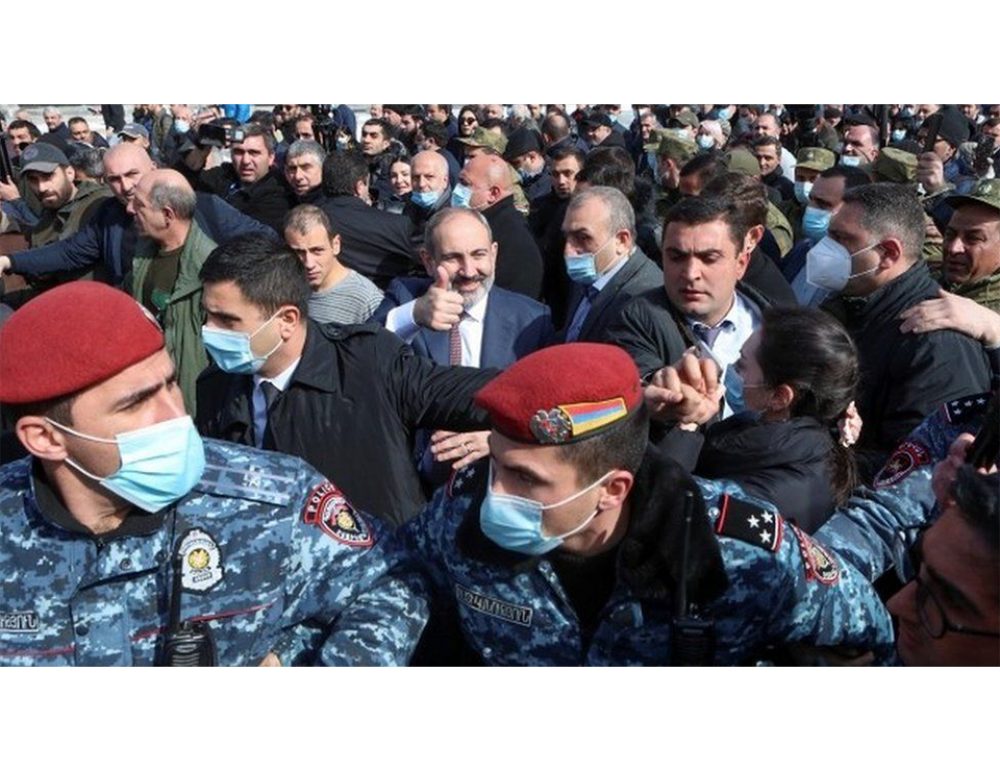
Moscow seems not to see any threats to itself from the political crisis in Armenia. The Kremlin realizes the toxicity of R. Kocharian and S. Sargsyan for the overwhelming majority of the Armenian population. Therefore, the Kremlin situationally “let go of the situation”, having leverage / control over both the Armenian prime minister and the security forces, not to mention the opposition. Apparently, R. Kocharian was offered by Moscow "to show the street." The demarche of the General Staff was supposed to support this. However, it is Pashinyan who confidently leads the street.
Armenia, as never before, faces the threat of civil confrontation and, accordingly, a challenge to the Armenian statehood, an ideal state in the logic of the Kremlin. Pashinyan will sooner or later bear political responsibility for the defeat in the 44-day war. However, hanging all the dogs on him is not fair at least. The opposition is putting pressure for his resignation, realizing that it can only come to power through a riot or "force majeure", so that later elections can be held according to its own rules and under its own people. In the current electoral configuration, the opposition is not interested in holding elections in “calm conditions”. Corresponding work in the army continues, while the clergy came out against the prime minister as a united front. President Armen Sarkissian took a break, and de facto refused to sign the resignation of Onik Gasparyan. At the last meeting of the Security Council, the President and the Chief of Staff were absent.
Even if the opposition manages to take a political revenge and come to power, it is not expected to make revisions on the 10 November agreement. It remains an exclusive prerogative of Moscow. The oppositionists, cynically speculating on the topic of military revenge, are not really going to engage in it. The motives are more mundane: to get to power and access to finance flows which will be allocated for restoring the Armenian economy, army, infrastructure.
Pashinyan will continue to fight. Certain contours of his situational strategy have been outlined: the idea of early elections has been revived, the topic of a referendum on amendments to the Constitution and a return to a "semi-presidential" form of government in October launched. The latter can institutionally strengthen the position of the current President Sarkissian, an influential figure both in Armenia and in international circles, regardless of his current ceremonial presidential powers.