

NATO's two-track deterrence policy: Where Ukraine's support fits in the strategy
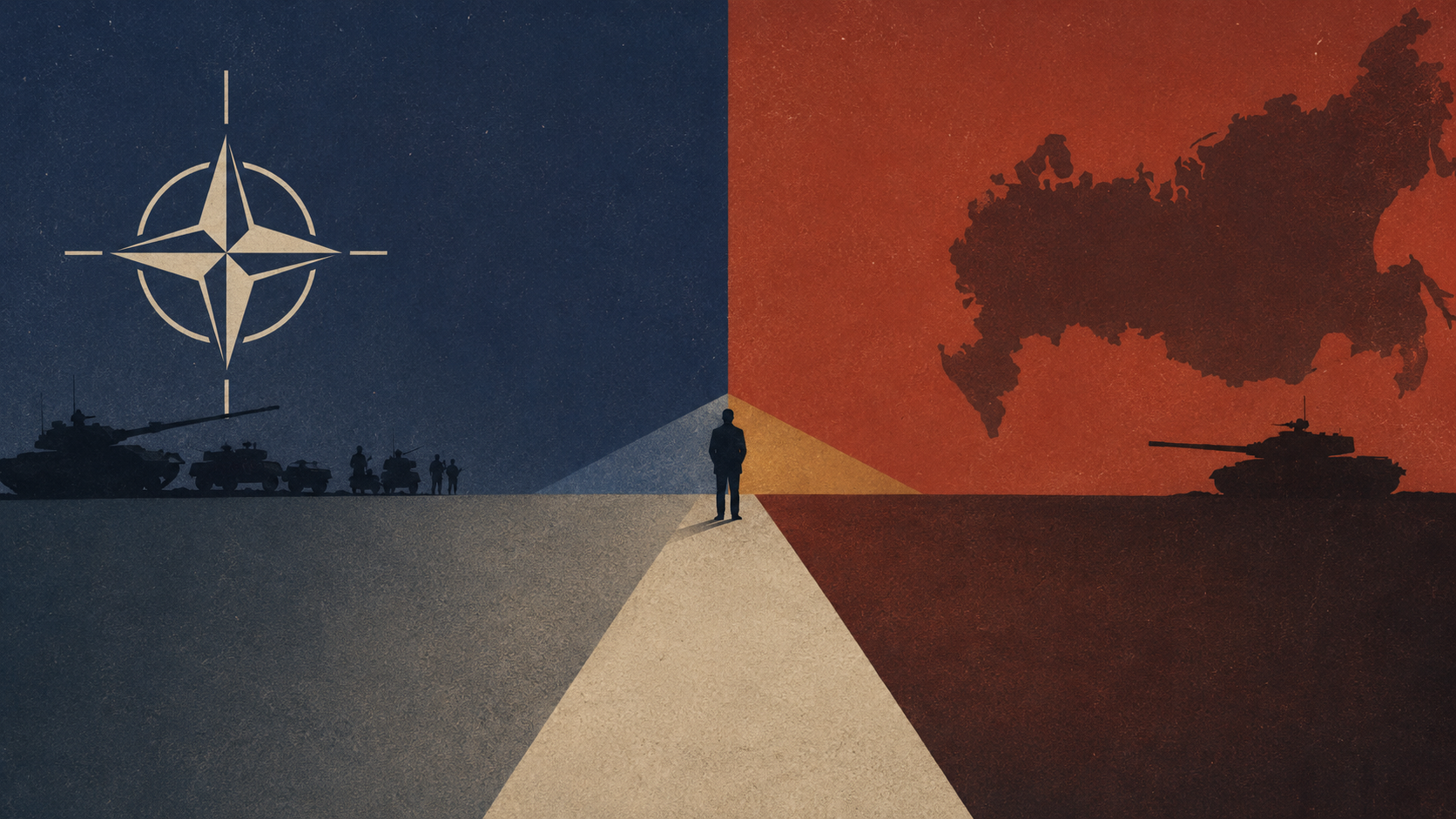
On December 3, 2025 NATO Secretary General Mark Rutte announced to member states' foreign ministers in Brussels that the alliance is officially abolishing the NATO-Russia Council and the 1997 Founding Act that gave it its legal basis. This mechanism had been inactive in practice since Russia suspended its mission in Brussels in 2021. Seven months later, allied leaders gathered for a summit in Ankara, where officials no longer discussed what they called “NATO 3.0,” a rebalancing of the alliance that aims to be less dependent on the U.S. but in which the U.S. would still remain the main pillar, as Rutte himself described it. Between these two points lies a paradox: the NATO position against Russia now appears at once more reinforced, more hastily prepared, and more personalized than it has ever been since the Cold War.
Today, nine multinational battle groups, stretching from Bulgaria to Finland, are deployed on the eastern front and have been expanded from battalion to brigade level since 2022. In response to Russian drone and aircraft incursions into allied airspace, real-time monitoring operations named Baltic Sentry, Eastern Sentry, and Arctic Sentry have also been added. Over all this rests the alliance's long-standing strategy of nuclear sharing: The U.S. stores B-61 bombs in the territory of five European allies, but retains sole authority over their use. This is deterrence built on the Article 5 logic of forces that are physically present, treaty-bound, and nuclear-armed on the territory of member states.
This “traditional” model is collapsing on its own terms. The Eastern Flank Deterrence Initiative revealed, in response to NATO's war simulations for 2026, that detection-strike times on the eastern front have been shortened to three to five minutes; This initiative is clearly a technological patch on the existing posture, not a replacement for it. Meanwhile, the core posture is weakening politically: the Trump administration has withdrawn roughly 5,000 troops from Germany and an entire brigade from Romania. A detailed ECFR study based on interviews in seven allied countries documents the resulting confusion: the North Atlantic Declaration, Macron's ‘forward deterrence’ doctrine, the nine European countries now in bilateral nuclear talks with Paris, and Russia's own parallel arsenal expansion, including the transfer of non-strategic warheads to Belarus in May 2026 and exercises involving 64,000 troops.
Support for Ukraine operates on a different logic and needs to be broken down into separate layers, as each has developed independently. The first layer is the NATO-coordinated arms channel. The Comprehensive Assistance Package is the umbrella framework, but NSATU and PURL are the mechanisms for the new business of delivering Western, primarily American, weapons to Ukraine: a commitment of $4.8 billion has been made through March 2026, and $4.2 billion has been delivered, The Atlantic Council, meanwhile, projects $5.5 billion by June.
Washington's own accounting system divides this into seven separate legal channels: draws from the president's contingency fund, security assistance funding, foreign military financing, PURL, third-party transfers, excess defense articles, and direct commercial sales; each of which is subject to the risk of change in U.S. policy.
Alongside it, a second, separate funding stream operates, doing structurally different work: instead of sending Western weapons to Ukraine, it gives money directly to Ukrainian factories to increase their own production. CSIS's testimony before Congress explains how this initiative, now called the “Danish model,” got started: The €50 million Danish tranche grew from funding eighteen howitzers delivered over two months to about $400 million in 2024, up to $6 billion in 2025. The Ukrainian Ministry of Defense, for its part, is forecasting $10 billion for next year. The Netherlands, Norway, and Germany have each developed their own versions; Denmark's own contribution is being made through a €175 million bilateral line, which is supplemented by €390 million from interest on frozen Russian assets and an additional €1 billion from the EU for 2025 alone, as well as a smaller contribution from Canada, Norway and Sweden tranches are also available. Special crowdfunding accounts for each contract, physical inspection of every delivered batch, and a completed Deloitte audit; These security measures were intentionally created, as directly financing private Ukrainian producers, as opposed to transferring the reserves of an allied government, carries a different risk profile.
The third layer is institutional depth, and it is more deeply rooted than both funding channels. By the end of 2021, Ukraine had already adopted 255 NATO standards and guiding documents; its command structure has since been rebuilt around NATO's J-/G-/M-/A- personnel system, and its C4ISR integration is conducted under strict U.S. reciprocity rules that require a security agreement signed before any capability transfer. More notably, Ukraine's battlefield experience is now feeding back into NATO doctrine through a four-stage channel: JATEC collects and analyzes front-line lessons, The Joint Battle Center in Norway incorporates them into training scenarios, the Joint Forces Training Center in Poland conducts the resulting exercises, and NATO's Joint Analysis and Lessons Learned Center (JALLC) writes them into alliance doctrine. The war that NATO initially started to help Ukraine survive has now become a war that NATO is actively learning from.
The fourth layer is private capital and Kyiv's own industrial policy. Since January 2026, Defence City has offered resident manufacturers corporate tax breaks on reinvested profits, simplified customs, and relaxed currency controls, which forms the regulatory foundation for Western investment. Germany's Quantum Systems, backed by Airbus and Blackstone, manages three separate manufacturing joint ventures in Ukraine; Auterion, along with a German-Ukrainian joint venture, has raised $130 million through a non-dilutive Pentagon grant to develop AI-powered strike kits; Munich-based Helsing is closing a $1.2 billion investment round at an $18 billion valuation, backed by Spotify founder Daniel Ek. Romania's state-backed SAFE program is funding technology transfer negotiations between fifteen Ukrainian drone manufacturers and local companies. The UK is applying its own version of its enabling regulatory model: a £3.5 billion UK Export Finance facility is providing an air defense package of about $2 billion based on Thales's Lightweight Multirole Missile, with Ukraine supplying the launch platforms. In 2023, BAE Systems established a local legal entity in Kyiv to repair L119 guns and is one of the industry teams competing under the Ministry of Defense's “Project Nightfall.” This project develops a 500-kilometer-range, ground-launched ballistic missile with a target price of less than £800,000 each. Ukrspecsystems, meanwhile, has raised £200 million to produce the PD-2 reconnaissance and Shark strike drones in the UK, not Ukraine; the reverse of the Rheinmetall model. That flagship project is an industrial, not a financial one: Rheinmetall's joint venture with Ukraine's state defense corporation, though predominantly German-owned, is set up to localize production in Ukraine rather than ship finished products west.
There are two gaps here, and their mirroring is noteworthy. The first one is political: Hungary's refusal to allow the transit of lethal weapons through its territory has caused the vast majority of deliveries to be routed through Poland, meaning that a single member's veto is already shaping the entire logistics picture without touching Article 5. The second is within Ukraine's own industrial base: Fire Point, the manufacturer of roughly half of Ukraine's long-range strike drones and now pivoting to satellites and a Tomahawk-class missile program, was at the center of leaked correspondence that tied businessman Timur Mindich to billions of dollars in contracts with the former defense minister; the scandal froze a planned Danish manufacturing facility and scuttled a potential UAE investment. The complex audit trail built into the Danish model exists precisely because the lack of such transparency is a known failure mode of direct industry funding; Fire Point shows that a protective measure and the risk it is intended to mitigate can coexist in the same ecosystem at the same time.
Another trend is not toward dependency, but rather away from it. Ukraine's own defense production capacity has grown from approximately $1 billion at the start of the war to the level indicated by Zelenskyy as over $35 billion by mid-2025, but the CSIS phrasing indicates that the state could only secure about $6 billion of the $20 billion in capacity that existed at the start of 2024; that is, production was ahead of the budget, not the other way around. By January 2026, Ukrainian officials have said that UK initiatives like UK Export Finance, Domestic manufacturers, increasingly supported through local industry partnerships with BAE Systems and joint capability development under Project Nightfall, provide more than half of the country's weapon systems, with capacity for this year standing at $55 billion. If this trajectory continues, the concept of “indirect deterrence” will be understood in a narrower sense: with each passing quarter, NATO is not endlessly funding some intermediary, but rather NATO and its members are jointly funding a bridge toward Ukraine's self-sufficiency. Going forward, the direct/indirect distinction on which this comparison is based may become less significant than how quickly Ukraine replaces Western transfers with its own production.