

Georgia’s opening to China: What Tbilisi’s deepening ties with Beijing really mean
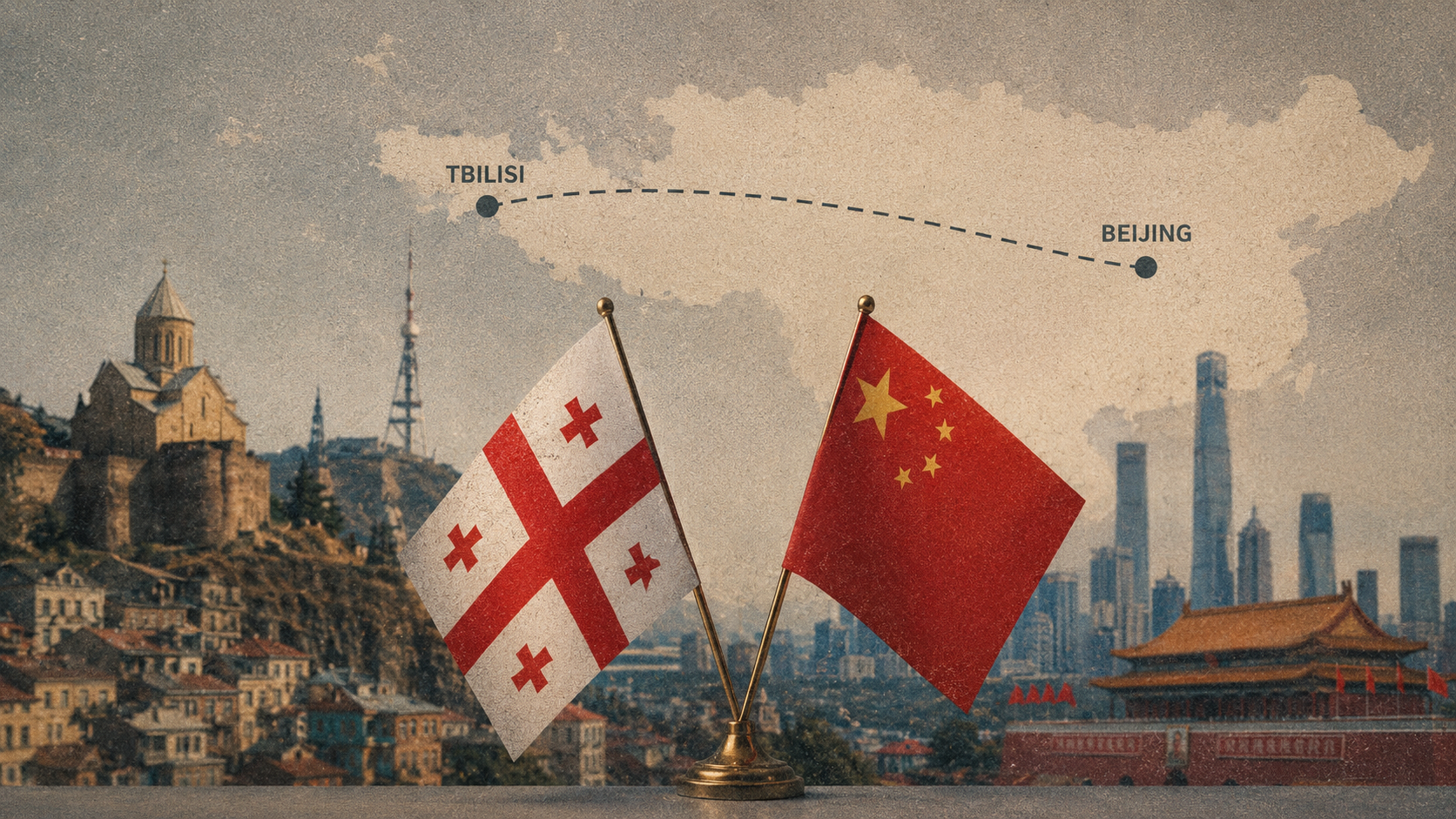
The first days of June 2026 offered a pointed reminder of how the South Caucasus remains one of the most contested geopolitical spaces in Eurasia. Within the span of twenty-four hours, two major developments, one in Washington, the other at the Chinese embassy in Tbilisi, brought Georgia's strategic positioning into sharper focus.
On June 8, the U.S. House of Representatives passed the “Countering China’s Control in the Caucasus Act,” mandating classified assessments of “the penetration of Russian and Chinese intelligence elements and their assets in Georgia” and of “the potential intersection of Russian and Chinese influence and cooperation in Georgia.” The following day, the Chinese Embassy in Tbilisi announced the elevation of Georgia-China relations to a Comprehensive Strategic Partnership, publishing letters exchanged between Chinese President Xi Jinping and Georgian President Mikheil Kavelashvili.
Behind the diplomatic choreography, however, a more complex picture emerges. The elevation of ties between Tbilisi and Beijing does not occur in a vacuum; it unfolds against a backdrop of infrastructure deals, Anaklia foremost among them, contested corridors, and a West that, for all its waning leverage in Tbilisi, remains unwilling to cede the field. Grasping what the partnership actually means requires looking past the announcement to the question it leaves unresolved: whether the upgrade marks a genuine strategic realignment toward Beijing or a tactical hedge dressed in the language of permanence.
Between Diplomatic Momentum and Economic Reality
As Georgia’s Euro-Atlantic trajectory has stalled, its relationship with Beijing has moved in the opposite direction. EU accession talks have been suspended, visa restrictions have been imposed on Georgian officials, and the strategic partnership with Washington has remained frozen since 2024. Over the same period, China-Georgia relations have acquired a steadily more formal political vocabulary. The strategic partnership, inaugurated in 2023, was elevated to a Comprehensive Strategic Partnership three years later, with Chinese President Xi Jinping and Georgian President Mikheil Kavelashvili exchanging congratulatory letters on the 34th anniversary of bilateral diplomatic relations.
The substance behind the diplomatic upgrade, however, remains less clear than the label suggests. Unlike the 2023 strategic partnership, which was sealed with a formal signing ceremony and a joint statement, the 2026 elevation was announced through an exchange of congratulatory letters, a notably restrained format for what Tbilisi has described as "an event of exceptional importance." The contrast matters because it suggests that the political value of the upgrade may currently exceed its institutional depth.
This, however, does not mean the relationship is empty. Since 2023, according to Prime Minister Irakli Kobakhidze, Georgia and China have signed 14 international agreements, with 6 more in the final stages of review, spanning infrastructure, tourism, aviation, and energy. These deals build on the existing Free Trade Agreement, in force since 2018 and recently upgraded, which covers approximately 94% of Georgian exports. In parallel, tourism and air connectivity have also expanded: Chinese visitor numbers rose by 83 percent in 2024 and by a further 44 percent in 2025, supported by the entry of three major Chinese carriers into the Georgian market.
Trade has grown as well. Bilateral trade expanded by 17% in 2024 and 21% in 2025, then surged an additional 45% between January and April 2026, positioning China as one of Georgia's premier trading partners. The structure of that trade reveals a deeper asymmetry. Georgian exports to China amounted to just USD 303 million in 2024, concentrated in raw materials and agricultural products, against USD 1.61 billion in imports.
The economic imbalance is mirrored at the political level too, where the asymmetry is no less striking. Georgia has consistently endorsed the One China principle, formally recognising Beijing’s position on Taiwan. China, for its part, has twice abstained from UN resolutions supporting the right of return of Georgian internally displaced persons from the de facto regions of Abkhazia and South Ossetia, and no joint document has ever stated an unambiguous endorsement of Georgian territorial integrity. Kobakhidze rationalised the omission as a matter of China’s “specific reasons”, a formulation that lays bare Beijing’s transactional pragmatism and the extent to which the relationship’s political concessions run in a single direction.
Read together, the commercial and diplomatic ledgers point in the same direction:
The Comprehensive Strategic Partnership is, for now, comprehensive chiefly in name. What Tbilisi presents as a strategic destination looks, on the available evidence, closer to a political signal, an upgrade rich in designation and thin in binding commitment.
Whether it hardens into something structural is the question the diplomatic text leaves unanswered, and it will be settled not in communiqués but in concrete. Elene Kintsurashvili, Senior Program Coordinator in the Transatlantic Security Program at the German Marshall Fund of the United States, argues that Georgia's engagement with China should not yet be read as a strategic realignment, but rather as a hedging strategy that functions "primarily as diplomatic leverage vis-à-vis the West." Yet she notes that Georgian Dream appears to be gradually broadening the scope of the relationship, raising questions about whether this pragmatic hedge could evolve into something more substantive should relations with the West continue to deteriorate.
Beijing’s Calculus: A Gateway, Not a Market
To fully understand Beijing's investment rationale, one must look beyond economic data and bilateral figures and instead consider the regional geographic context. Georgia’s strategic importance to China lies not in trade flows but in its location. As the Black Sea endpoint of the Middle Corridor, the established trans-Eurasian route from Xinjiang through Central Asia, crossing the Caspian Sea into the South Caucasus, it serves as the final land link enabling Chinese goods to reach Europe, bypassing Russia and the most exposed maritime chokepoints.
This route’s appeal has grown as alternatives have become more exposed: Russia’s war in Ukraine has made the Northern Corridor politically sensitive, while tensions in the Red Sea and the Strait of Hormuz have highlighted the fragility of southern maritime routes. Against this backdrop, Georgian officials reported that container shipments between China and Georgia via the Middle Corridor increased by 71 per cent from January to August 2025.
For Beijing, then, Georgia’s value is primarily positional. The country is not a major market, but it is a potential conduit. Its Black Sea access, railway links, and proximity to European markets make it an important node in any effort to diversify China-Europe connectivity away from routes exposed to war, sanctions, or maritime disruption.
The upgraded partnership, therefore, points less to a conventional bilateral economic relationship than to China’s effort to secure a more durable role in the infrastructure politics of the South Caucasus.
Yet that value is not unconditional. As Kintsurashvili points out, much of Georgia's appeal to Beijing rested on its role as a stable gateway to European markets, anchored in its ties to the EU. As those ties fray, it remains an open question whether Georgia retains the same worth in Beijing's calculus, or whether Chinese engagement becomes more selective and transactional.
The Middle Corridor: Georgia’s Infrastructure Test
If geography explains the potential strategic value of Beijing and Tbilisi's upgraded cooperation, it also explains why Georgia’s choices could reverberate far beyond its borders. The Middle Corridor is not a national project but rather a global ecosystem, and its viability rests on the collective confidence of the state operators who have staked their connectivity strategies on it. Over the last few years, the ecosystem has consolidated rapidly: Kazakhstan has invested heavily in reducing bottlenecks at its Caspian ports, Azerbaijan has positioned itself as the corridor's logistical spine through the Baku-Tbilisi-Kars railway and its Caspian terminals, and Türkiye has turned infrastructure diplomacy into a vehicle for regional influence. The entry of China Railway Container Transport Corp into the Middle Corridor joint venture in August 2025 marked a further shift, signalling that Beijing intends to be an operational stakeholder along the route, not merely a distant customer.
Within this architecture, Georgia occupies a singular position: it is the corridor’s western terminus and a direct gateway to the Black Sea and European markets. Nevertheless, this centrality presents a potential risk, rendering Georgia a weak link and a structurally vulnerable node within the corridor. All rail freight moving westward from Baku toward the Black Sea passes through Georgian territory. That makes the corridor only as reliable as Georgia's own stability, and as predictable as its political choices.
Georgia’s maritime infrastructure is therefore central to the corridor’s future. At present, the Port of Poti handles the majority of the country’s container traffic, but draft limitations restrict its ability to accommodate larger vessels. This bottleneck explains why the long-delayed Anaklia Deep-Sea Port has significance beyond its commercial value. Anaklia is not merely an infrastructure project. It is the point at which Georgia’s diplomatic balancing, Black Sea connectivity, and role in the Middle Corridor converge.
Anaklia has also carried symbolic weight in Georgian politics. It has often been associated with Georgia’s Western integration narrative, both because of its location on the Black Sea and because of its potential to connect the country more closely to European markets. Under the previously proposed structure, the Georgian state would have retained 51 per cent of the project, while the private partner would have held 49 per cent. This would not have amounted to outright Chinese control. However, it could still have given a Chinese-led consortium a durable role in the governance and operation of a critical infrastructure node at the western end of the Middle Corridor. The government’s subsequent shift toward a landlord model, under which the state would own the core maritime and port infrastructure while welcoming international companies to participate in terminal operations, complicates this picture. More than two years after the Chinese-Singaporean consortium was selected as the preferred private partner, the concession agreement has not been finalised. Instead, the Georgian government has announced that Anaklia will be developed under a “landlord model,” with the state retaining ownership of the core maritime and port infrastructure and overseeing its development and management. International companies and partner countries may still participate, particularly in terminal infrastructure, but the project is no longer framed around a single dominant investor.
This shift changes, rather than removes, Anaklia’s strategic significance. On the one hand, it reduces the likelihood that Beijing will acquire direct ownership of the port’s core infrastructure. On the other hand, it does not exclude Chinese participation. Georgian officials have explicitly welcomed investment from Middle Corridor countries, including China, Central Asian republics, and Azerbaijan.
Anaklia, therefore, remains a practical test of Georgia’s orientation. Still, the test has become more specific: not whether a Chinese-led consortium formally owns the port, but whether Chinese firms acquire durable operational influence within its terminals, logistics chains, financing structures, or governance ecosystem.
If Chinese participation remains limited and embedded within a diversified, state-led model, Anaklia would support the view that Tbilisi’s China policy remains primarily tactical. If, however, Chinese firms gain significant operational leverage inside the port’s commercial architecture, the project could still mark a qualitative shift in Georgia’s relationship with Beijing. In either case, the evolution of Anaklia will reveal more about the substance of Georgia’s China policy than the language of the Comprehensive Strategic Partnership itself.
Navigating Ambiguity: Implications and Scenarios
The current trajectory of Georgia’s foreign policy reflects a highly deliberate, multi-vector hedging strategy by the ruling Georgian Dream coalition. In this framework, Beijing is increasingly utilised as a sovereign shield, a powerful non-Western partner capable of offering economic and political legitimacy without the conditionalities of democratic reforms, judicial oversight, or human rights alignment that Brussels and Washington have traditionally demanded. As Kintsurashvili puts it, China does not shield the Georgian state from external threats; it shields the government from Western political conditionality.
Yet, even as Tbilisi deepens ties with China, it continues to make quiet attempts at a strategic reset with Washington. The wager within the government is that the West's long-term interest in a viable Middle Corridor will ultimately force Washington and Brussels to accept a more transactional relationship, overriding their normative concerns.
This balancing act is also reinforced through regional formats. By strengthening its trilateral alignment with Türkiye and Azerbaijan, including through the Istanbul Declaration, Georgia seeks to present its logistical and security posture as embedded in a regional consensus rather than dependent on China alone. This allows Tbilisi to argue that its foreign policy remains coherent, balanced, and rooted in cooperation with its immediate neighbours. However, this synthesis is becoming increasingly fragile. As rivalry between Washington and Beijing intensifies, the geopolitical space required to maintain such calculated ambiguity is narrowing. What Georgian Dream presents as sovereign diversification is increasingly likely to be viewed by Western security planners as a source of strategic vulnerability.
There is, however, a paradox that complicates this picture. As Kintsurashvili notes, Georgia's deepening engagement with China may, in fact, increase rather than diminish its strategic importance for Washington: the more Beijing embeds itself in the corridor, the less the United States can afford to disengage from the South Caucasus.
Beneath these tactical calculations lies a deeper structural problem: the Middle Corridor has no shared governance, and the actors who depend on it view it through fundamentally incompatible prisms. While the West envisions a transparent, competitive commercial corridor designed to bypass authoritarian monopolies, Beijing approaches the route through the lens of state-directed supply-chain security, seeking reliable access to, and, where possible, operational influence over, critical infrastructure. Concurrently, regional middle powers such as Ankara, Baku, and Astana view the route primarily as a historic vehicle to maximise their own national sovereignty, strategic autonomy, and regional leverage.
Turning this competitive matrix into a stable artery would require multilateral governance that can separate infrastructure management from zero-sum geopolitical rivalry. If the involved powers lack the strategic patience to build these collaborative mechanisms, the Middle Corridor risks becoming a casualty of its own geographical importance, turning Georgia’s internal vulnerabilities and its ambiguous balancing act into a volatile geopolitical friction point where global rivalries collide rather than cooperate.