

Where is the South Caucasus in the U.S. Critical Minerals Strategy?
For decades, the South Caucasus has provided Europe with an alternative corridor to strategic energy resources from the Caspian basin, particularly at the moments of heightened tension with Russia. Oil and gas exports from the region formed the backbone of this interregional partnership, supporting the European Union’s energy diversification efforts while contributing to the economic resilience of the region’s states. Today, however, the global energy system is undergoing a structural transformation. Intensifying competition over green technologies and the gradual regionalization of traditional fuel markets are reshaping energy geopolitics, hence forcing the South Caucasus countries to reassess their strategic relevance.
Two developments, in particular, are driving the region’s renewed importance. First, it is emerging as both a source of and a transit corridor for green electricity destined for European markets, complementing oil and gas transit arrangements that continue to dominate regional energy cooperation. Undersea electricity cable projects across the Black Sea and the Caspian Sea, alongside longer-term ambitions to export green hydrogen, reflect this evolving agenda.
More consequential, however, is Central Asia’s growing prominence in U.S. and European efforts to secure access to critical minerals. As a result, the South Caucasus is increasingly positioned as a logistical and geopolitical link in newly forming interregional supply chains.
Minerals such as lithium, cobalt, and nickel, indispensable for defense production and green energy technologies, have become strategic assets, prompting major powers to move swiftly to diversify and secure their supply chains.
Yet access to these resources depends less on geology than on connectivity. Against this backdrop, the normalization process between Armenia and Azerbaijan and the prospective implementation of the Trump Route for International Peace and Prosperity (TRIPP) could fundamentally alter the region’s role in trans-Caspian trade. For decades, unresolved conflict over Karabakh made the South Caucasus one of the key bottlenecks in regional connectivity. The post–Washington Declaration momentum, by contrast, has strengthened regional stability, a prerequisite for integrating the South Caucasus into global value and supply chains.
US-China rivalry over critical minerals
The simmering rivalry between the United States and China has brought critical minerals to the center of great-power competition. The United States and the European Union entered this race considerably later than China, which today dominates both the mining and, more importantly, the processing segments of global supply chains. Even where minerals are extracted domestically, Washington remains heavily dependent on Chinese processing capacity, a structural vulnerability that has become increasingly difficult to ignore.
As the Trump administration has come to view competition with China in increasingly zero-sum terms, extending from semiconductors to shipbuilding, Beijing has demonstrated its willingness to weaponize critical minerals exports in trade disputes with both the US and the EU.
Although China rolled back tighter export controls in late 2025, the episode exposed the scale of Western dependence and accelerated Washington’s search for mechanisms that could help offset this asymmetry.
The United States has pursued a two-track strategy to reduce its exposure to China-driven supply shocks. The first pillar focuses on domestic production. Marking a clear departure from the Biden administration's policies, President Trump prioritized accelerated permitting, regulatory streamlining, and expanded mining activity. In early 2025, he signed executive orders aimed at rapidly increasing U.S. mineral output and initiating the development of seabed mineral resources. This effort was further institutionalized on February 2 with the launch of Project Vault, a strategic domestic stockpile of 60 critical minerals, backed by long-term financing from the Export-Import Bank of the United States. The initiative is designed to stabilize domestic markets, shield U.S. producers from China’s price manipulation, and inject predictability into investment decisions.
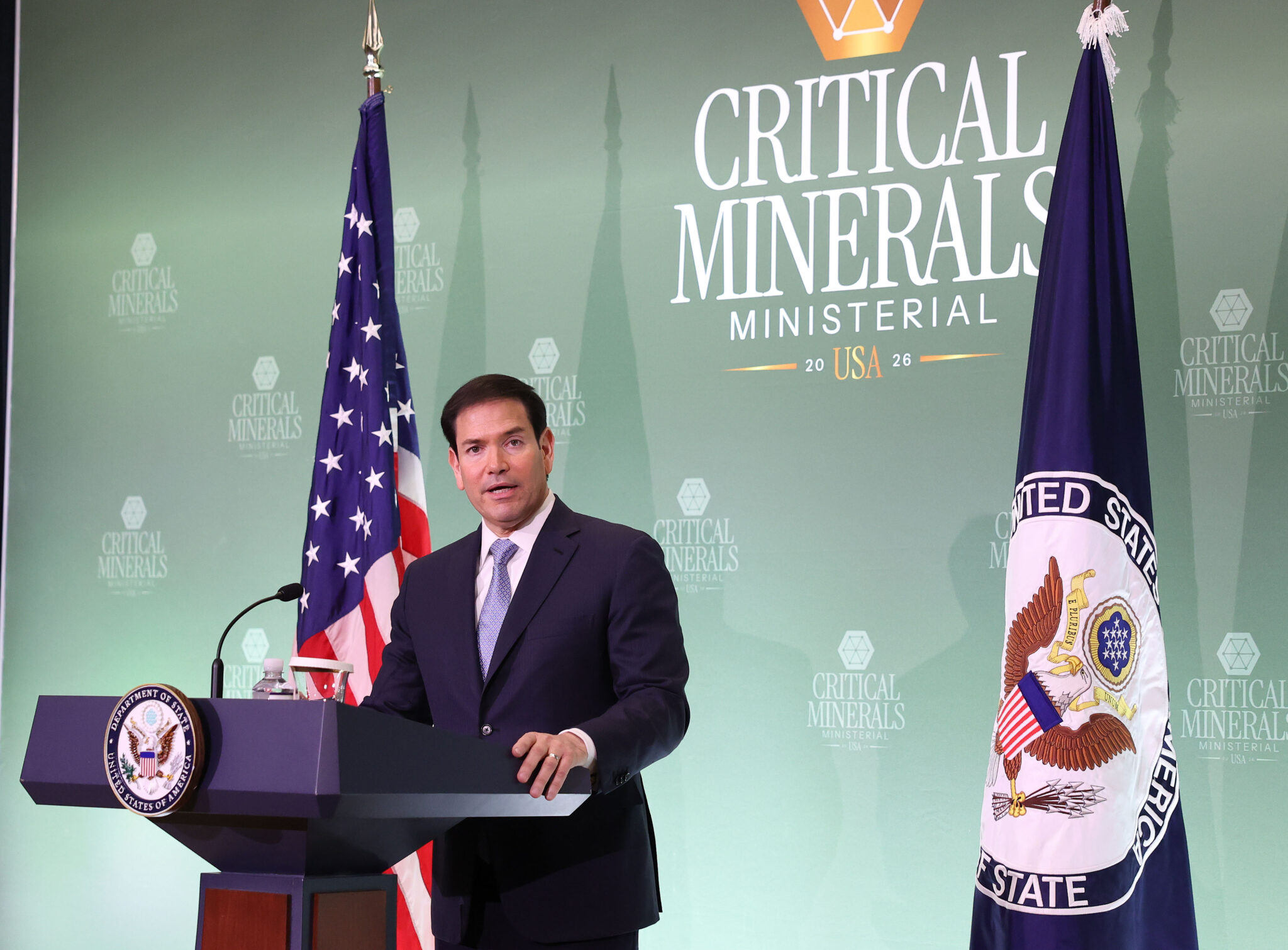
The second pillar centers on external partnerships. Washington has moved to construct new bilateral and multilateral frameworks with like-minded countries to secure diversified and resilient supply chains for strategic minerals. The February 4 Critical Minerals Ministerial in Washington, which convened officials and industry representatives from 55 partner states, marked a significant step in this direction. The most consequential outcome was the launch of the Forum on Resource Geostrategic Engagement (FORGE), a multilateral platform building on, but also expanding beyond, the Biden-era Minerals Security Partnership framework. FORGE aims to harmonize regulatory standards, align financing instruments, and coordinate investment screening across jurisdictions. Most notably, it envisages the creation of a preferential trade zone for critical minerals with enforceable price floors, a mechanism that, if implemented effectively, could introduce badly-missing predictability into minerals markets and incentivize production across the United States and allied economies.
The growing prominence of Central Asia within this strategy was evident at the ministerial. Delegations from Armenia, Kazakhstan, and Uzbekistan attended, underscoring Washington’s growing interest in the region’s mineral potential. During the event, Uzbekistan signed a memorandum of understanding with the United States on developing critical minerals cooperation in line with international standards on transparency, environmental sustainability, and high-value-added production. A similar agreement was concluded with Kazakhstan in November 2025, on the sidelines of the C5+1 summit at the White House. Under this framework, a U.S. mining investment firm is set to jointly develop a major tungsten deposit in Kazakhstan, with the U.S. International Development Finance Corporation exploring up to $700 million in financing for the project. Central Asia’s gradual integration into U.S.-led critical minerals supply chains highlights a challenge that extends beyond extraction and investment.
Securing these flows will require reliable connectivity, most notably, a stable trans-Caspian route and a functional Turkey–South Caucasus–Central Asia corridor capable of supporting sustained coordination among governments, investors, and industrial stakeholders.
Vance’s visit and expectations
Critical minerals featured on the agenda of U.S. Vice President James Vance’s February visit to Armenia and Azerbaijan, but they ranked below other strategic priorities, most notably nuclear energy and AI technologies. Washington appears to view the South Caucasus less as a primary extraction hub and more as a strategic transit link, one that can facilitate access to Central Asia’s mineral deposits. In Armenia, discussions centered on the Trump Route for International Peace and Prosperity (TRIPP), which is intended to connect Azerbaijan with its Nakhchivan exclave through southern Armenia and unlock the region’s latent transit potential. The recently published TRIPP Implementation Framework explicitly notes that the corridor would serve U.S. interests by enabling the movement of raw materials, critical minerals, and rare earth elements to American markets. In Azerbaijan, this emphasis was reinforced by the Strategic Partnership Charter signed by Vice President Vance and President Aliyev, which commits both sides to cooperating on the transit of critical minerals via the Middle Corridor.
U.S. backing for the Middle Corridor comes on the heels of slow but meaningful involvement of the European Union and China in the development of the route, marking a significant diplomatic and strategic gain for Baku and other states along the route seeking to elevate its role in Eurasian connectivity. By linking TRIPP to the trans-Caspian transport network, Washington is pursuing two objectives simultaneously: securing reliable access to Central Asia’s critical minerals and advancing its “peace through prosperity” approach by embedding Armenia and Azerbaijan within a shared trade and transport ecosystem.
The next logical step would be to attract U.S. investment into local extraction and processing industries. During his meeting with Vance, Armenian Prime Minister Nikol Pashinyan signaled Yerevan’s readiness to cooperate with Washington on critical minerals supply chains, a position further underscored by Armenia’s invitation to the Critical Minerals Ministerial in Washington. Taken together, these signals suggest that the United States increasingly sees Armenia, and by extension the South Caucasus, as part of a broader strategy to reshape global competition over strategic resources.
Yet expectations should remain measured. Neither Armenia nor Azerbaijan currently hosts large-scale, operational critical minerals deposits comparable to those found in Central Asia. Small quantities of rare earth elements have been identified within copper and molybdenum fields in both countries, but the technological base and institutional capacity needed to develop these resources remain limited. Mining projects require substantial upfront capital, involve long payback periods, and are particularly vulnerable to geopolitical instability, constraints that both countries will need to overcome to embed themselves meaningfully into global minerals supply chains.
Ultimately, the durability of U.S. engagement will be the decisive variable. For their part, Armenia and Azerbaijan must ensure that regional stability is sufficiently entrenched to attract long-term foreign investment.
If Washington and Brussels follow through on their plans to build diversified supply chains linked to Central Asia, the South Caucasus may yet gain an opportunity to develop its own modest resource base, potentially emulating Mongolia’s “Third Neighbor” strategy to diversify economic ties beyond Russia, while anchoring regional peace to large-scale, forward-looking economic projects. Another useful reference point could be the U.S.-brokered minerals-for-stability arrangement between the Democratic Republic of Congo and Rwanda. There, Washington framed access to strategic mineral supply chains not as a zero-sum achievement, but as a shared economic incentive capable of alleviating security dilemmas and aligning the interests of rival states. By anchoring Armenia-Azerbaijan normalization to transit revenues, infrastructure integration, and participation in U.S.- and EU-backed critical minerals supply chains, Washington could simultaneously advance its geoeconomic objectives and reinforce the material foundations of a durable peace.