

The Modernization of Azerbaijan’s Military Industry Model
On June 19, Azerbaijan’s President Ilham Aliyev amended the laws regarding import taxes. Among the changes was the transfer of authority for exempting technology imports from VAT to the Ministry of Defense Industry. What might seem like a generic bureaucratic change is instead part of a broader pattern of Azerbaijan’s transformation of its defense-industrial complex. The country is actively developing its domestic military production sector in addition to pursuing foreign procurement, and, most importantly, the approach it is taking represents a clear break from the old Soviet tradition toward a modern, diversified model based on the experiences of recent conflicts.
What can now be observed is the gradual emergence of a wide variety of private defense technology companies that maintain close ties with state institutions supporting their growth. The country’s foreign cooperation and procurement of foreign equipment have been well-established trends for years, but the current developments in the defense industry landscape should not be underestimated and may become one of the key drivers of military modernization in the coming years.
The Ministry of Defense Industry (MDI) of Azerbaijan was established in 2005 and built on the foundation of the dissolved Special Machinery Manufacturing and Conversion Committee. Among the MDI’s responsibilities are fulfilling state defense orders through production or procurement and coordinating the country’s defense-industrial sector. Numerous production facilities and specialized enterprises fall under the MDI’s authority, including research institutes and domestic manufacturing giants such as Azersilah.
It was no secret that Azerbaijan’s initial defense industry model was almost exclusively state-centered, in keeping with the traditions of the Soviet Union. The country’s president remarked earlier this year that “we assessed it as a monopoly at the time” when describing the MDI in an interview. Over time, however, the leadership appears to have come to appreciate the benefits of a diversified defense industry model that incorporates private companies. Close military cooperation and exchange of experience with Türkiye may have contributed to Azerbaijan’s gradual shift in this regard. Participation of private actors in the defense sector was liberalized during the first half of the 2020s, and by early 2026, 15 companies had been licensed to operate in this field, which had traditionally been reserved for the state.
What is particularly interesting about these private companies is that most already have clearly defined areas of specialization and established product and service portfolios. Judging by their continued recruitment of specialists and active participation in domestic and international defense exhibitions, it is evident that their expansion is underway. These factors challenge claims that Azerbaijan’s private defense industry may be an empty shell used for propaganda purposes. Instead, the state appears to be actively supporting these emerging firms by increasing their international exposure rather than limiting their activities.
A detailed overview reveals the diversity of the country’s emerging private defense sector.
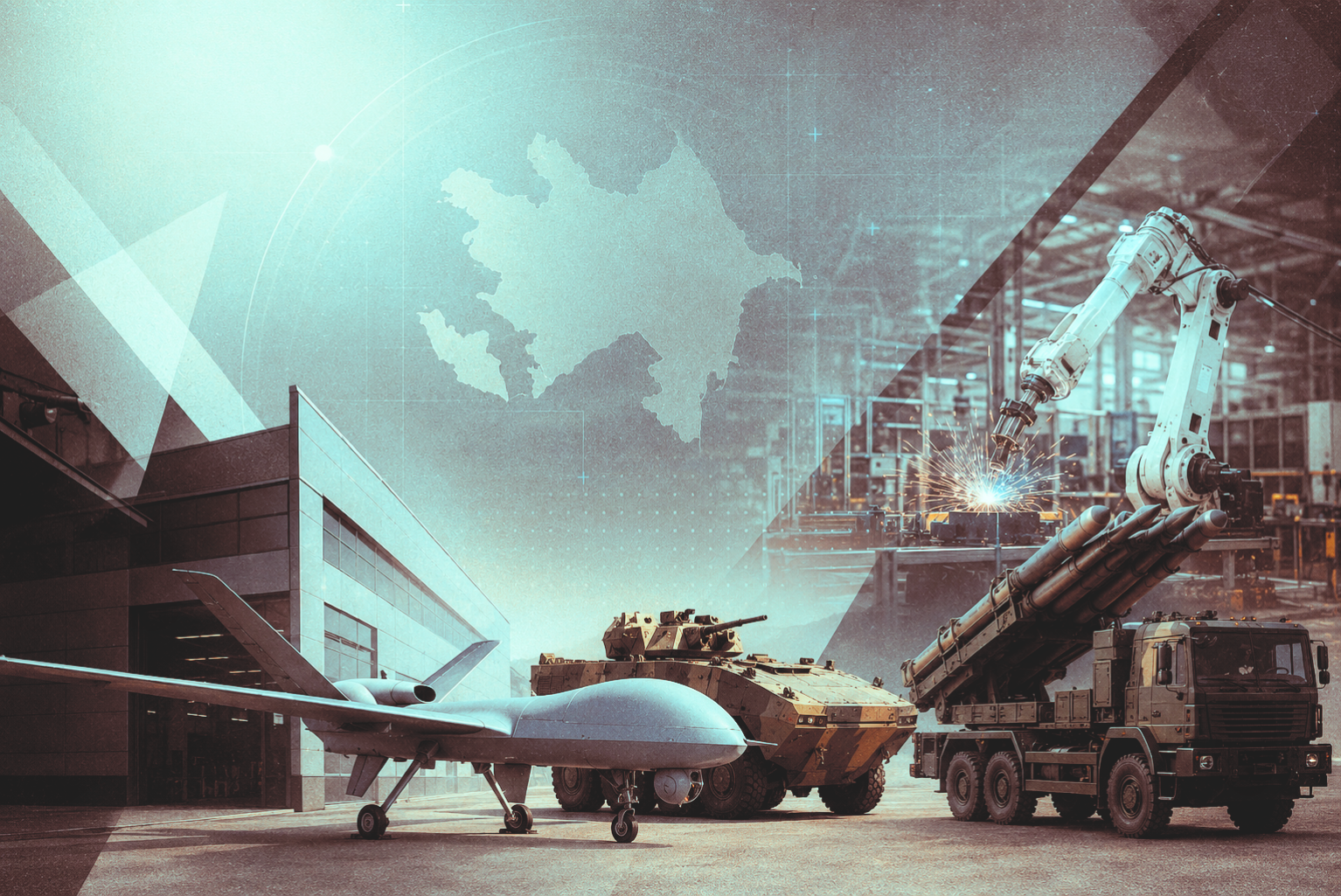
Azerbaijan-based defense companies are involved in the production of goods and services ranging from specialized military uniforms to armored personnel carriers and AI-based autonomous capability models for unmanned systems.
Among the more established private defense manufacturers is Importex LLC, which focuses on the production of armored mine-resistant transport vehicles and specialized engineering vehicles for military use. Some of the company’s recent products include the ITX-20H armored vehicle and the Revival P1 mine-clearing unmanned ground vehicle (UGV). In addition to conventional military equipment, several companies are focusing on high-tech capabilities that have become particularly relevant following Russia’s invasion of Ukraine in 2022. The Baku-based Synapline, for instance, specializes in AI-powered autonomous UAV capabilities for combat in GPS-contested environments. The company is also involved in the production of strike drones. It is, however, far from the only drone manufacturer to emerge in Azerbaijan in recent years. Azerbaijani companies RD Defense and Azshield presented various UAV models at this year’s World Defense Show in Riyadh, including interceptor drones, which have become crucial weapons employed by both sides in the Russia–Ukraine war.
This is by no means an exhaustive list of the private firms actively involved in Azerbaijan’s defense industry. Numerous other companies are expanding their activities in various areas and are likely already making significant contributions to the modernization of the country’s armed forces.
As these companies continue their international outreach and establish connections with foreign partners, opportunities for cooperation with both state-owned and private defense technology firms, as well as potential exports to international markets, become increasingly plausible. As Azerbaijan’s foremost military partner and a major supplier of defense technology, Türkiye appears to be the most accessible and likely candidate for the development of joint projects and agreements. Azerbaijani and Turkish private and state defense companies are already strengthening ties through events such as the International Defence Industry Fair held in Istanbul in 2025. These firms are likely to benefit significantly from the close relationship between the two countries and their broad cooperation across multiple sectors.
The evolution of Azerbaijan’s defense industrial complex from a rigid, state-monopolized Soviet legacy into an agile, diversified ecosystem underscores a calculated shift toward long-term strategic self-reliance.
By leveraging regulatory reforms like the June 2026 tax amendments to lower financial barriers, Baku is actively cultivating a domestic network of licensed private firms capable of driving high-tech innovation. Rather than operating as mere experimental concepts, these emerging private actors are already demonstrating their maturity through physical footprints at global defense expos, active recruitment of specialized domestic expertise, and targeted innovation in fields ranging from tactical manufacturing to autonomous systems.
As Azerbaijan’s defense industry continues to move away from the legacy of the Soviet model and increasingly integrate a growing number of private defense startups into its ecosystem, the country’s military modernization and procurement patterns are likely to evolve. Foreign acquisitions will increasingly be supplemented, rather than entirely replaced, by domestically and privately produced equipment, providing greater control over the final product while strengthening the country’s industrial base and critical technical expertise. Equally important is the fact that the presence of domestic private expertise will create opportunities for the development of systems tailored to the specific requirements of the armed forces, as well as the adaptation of foreign-procured equipment to local conditions. The overall trajectory of Azerbaijan’s defense industry therefore appears promising.